Spine Motion Guide

Comparison

Spinal fusion vs. TOPS

Both options are usually discussed after a plan to decompress pinched nerves. Fusion joins a spinal level so it no longer moves. TOPS is an implant meant to stabilize that level while keeping some motion. This page maps the difference. It does not pick a winner.

Editorially reviewed: September 2, 2026

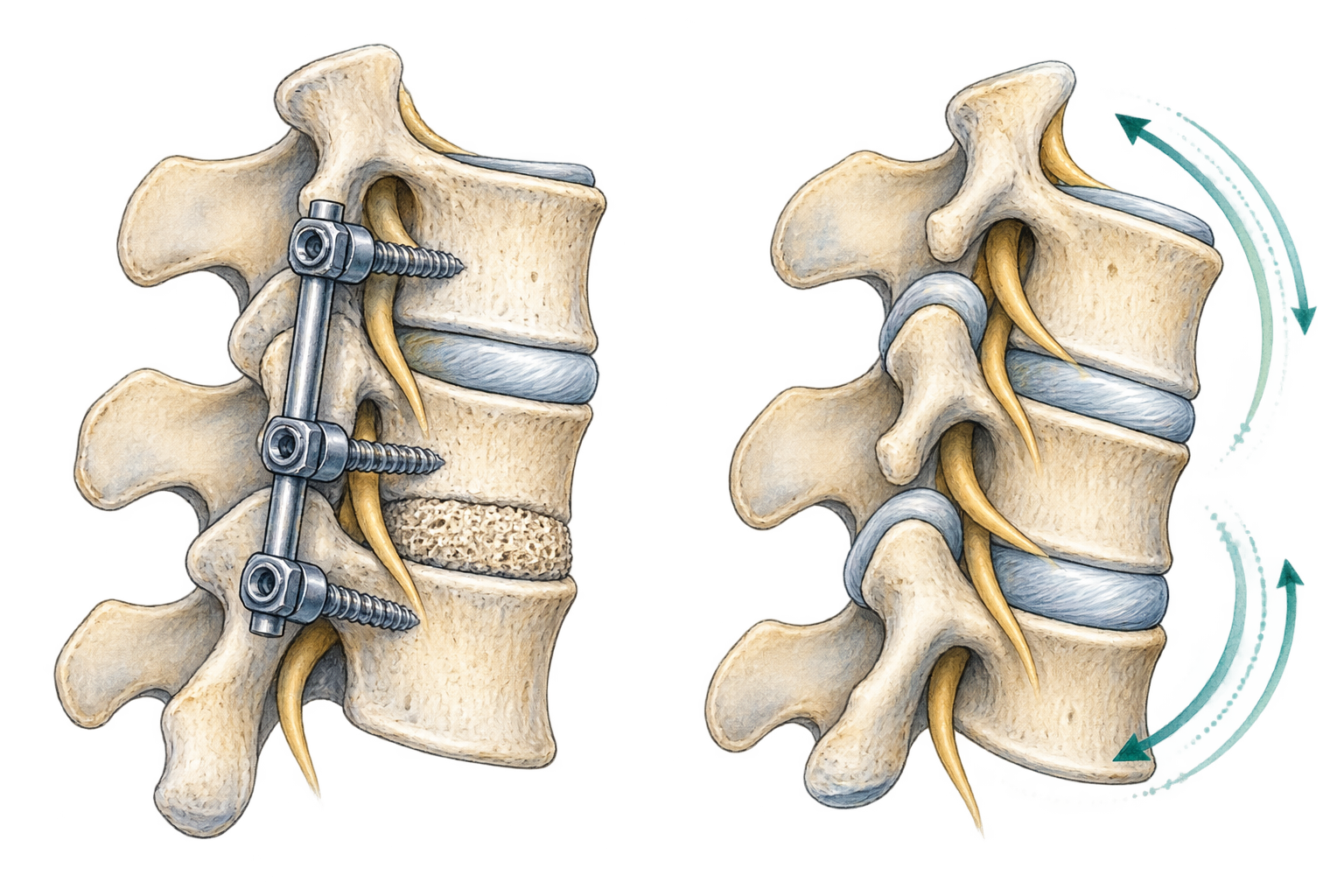
Conceptual comparison of rigid lumbar fusion and preserved spinal motion

How to use this comparison

Stenosis is a narrowing around nerves. Degenerative spondylolisthesis, when it is part of the picture, is a mild forward slip of one vertebra on another. Decompression treats the narrowing. Fusion and TOPS treat what happens to that spinal segment afterward.

Use the table to see the structural difference. Use theclinical evidence page for trial numbers, statistical status, and the FDA-approved indication. A comparison chart cannot tell you which operation, if any, fits your imaging.

Side-by-side differences

Educational comparison of spinal fusion and TOPS after decompression.
TopicSpinal fusionTOPS (motion-preserving)
What the extra hardware is forAfter decompression, bone graft and instrumentation are used so selected vertebrae heal into one non-moving unit.After decompression, a posterior implant and pedicle screws are used to stabilize the level while allowing some controlled motion.
Motion at the treated levelThat level is meant to stop moving after it heals.That level is meant to keep some movement. How the FDA trial treated motion versus fusion is explained with the study results, not as a promise about everyday activity.
When a surgeon may raise itWhen the record shows a reason to immobilize the level, such as instability, alignment, or other findings the surgeon can point to.When the person may fit the labeled indication: a selected stenosis picture with mild degenerative slip at one level from L3 to L5. Exact matching is clinical work, not a website table.
Where the evidence livesFusion has a long clinical literature. This page does not try to summarize all of it.TOPS has a U.S. randomized comparison with fusion in a defined group. Design, results, safety, and limits are on the clinical evidence page.

For the 24-month composite result, safety rates, and what was not statistically significant, readwhat the clinical evidence says about TOPS versus fusion.

Where decompression fits

Decompression is the nerve-room operation: removing bone or ligament that is crowding a nerve. Fusion and TOPS are reconstructions of the segment after that work, or when the surgeon already thinks the segment is unstable. Mixing those jobs into one slogan is how patient materials become confusing. Some people never need the second job. Some do.

Questions for a consultation

  • What exactly is being decompressed, and at which levels?
  • If fusion is recommended, what instability or alignment problem is it treating?
  • If TOPS is recommended, do I match the labeled indication, including spinal level?
  • What would decompression alone look like in my case?
  • What does recovery involve in this practice, without promised percentages?

You can gather history first with thecandidacy questionnaire. It organizes questions. It does not approve or exclude anyone.

Is TOPS a replacement for every fusion?

No. The procedures overlap in conversation, not in every anatomy. Imaging, examination, and the labeled indication decide what can even be offered.

Did the FDA study prove TOPS is better in every way?

No. FDA concluded superiority on a prespecified composite success score at 24 months in the evaluated trial group. Several other comparisons were not statistically significant. The details are on the clinical evidence page.

Can decompression without implants be enough?

For some people, decompression alone is the operation under discussion. Fusion and TOPS are extra reconstructive choices, not the only surgical paths.