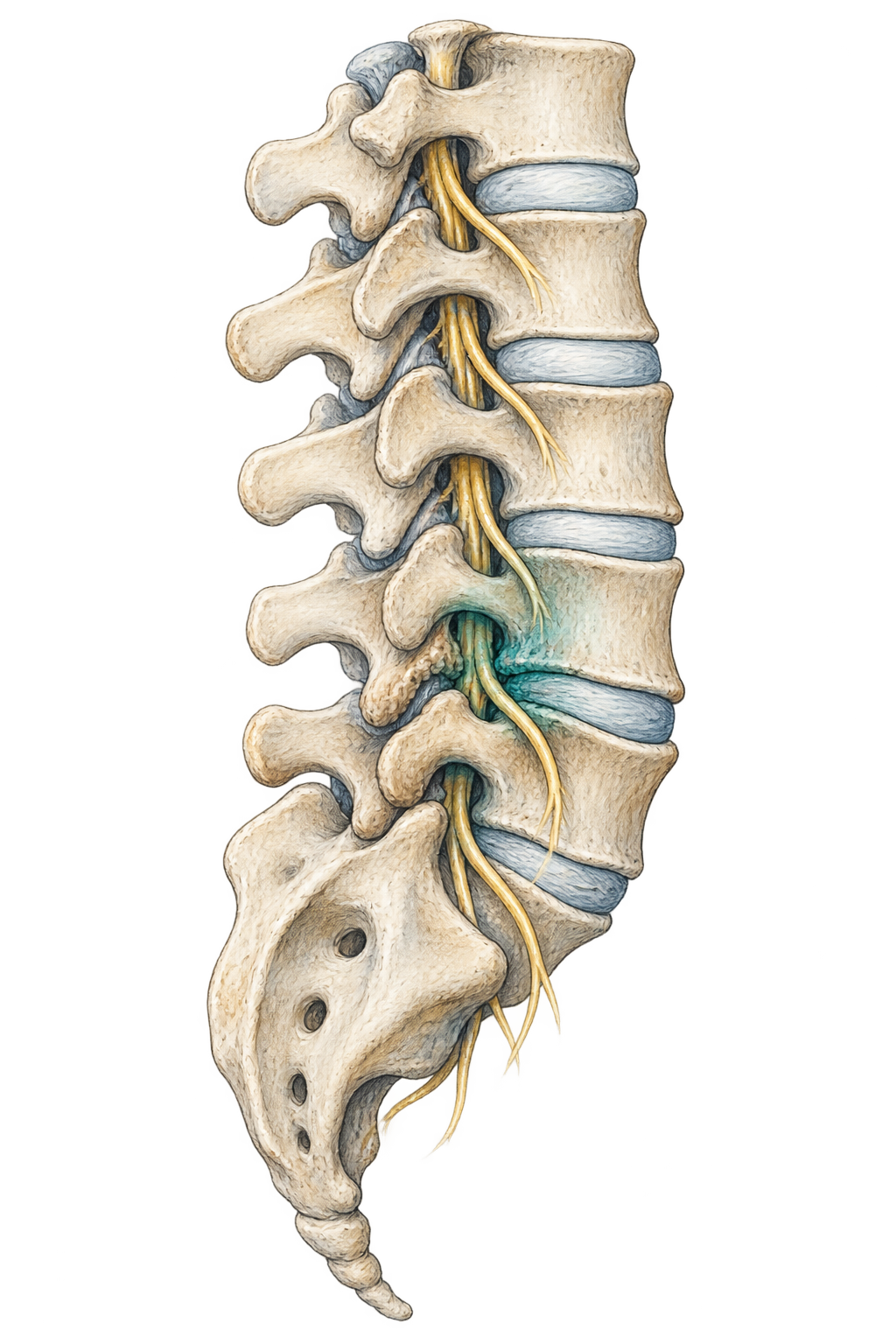
Lumbar spinal stenosis is a narrowing around nerves in the lower back. Standing or walking may bring on leg pain, heaviness, or numbness that eases when you sit or lean forward. That pattern is a clue, not a diagnosis. Imaging and a clinician still have to say what is going on.
If surgery enters the conversation, the first mechanical job is often decompression: making more room for the affected nerves. When people search for a spinal fusion alternative for spinal stenosis, what happens next is a separate question.
Some are treated with decompression alone. Some are offered fusion, which joins a spinal level so it no longer moves. Some selected patients are discussed for TOPS, an implant meant to stabilize that level while keeping some motion.
Those are different reconstructions, not three names for the same operation. The fusion versus TOPS comparison explains the practical difference. The clinical evidence page explains what FDA reviewed for TOPS, and what that review did not prove.