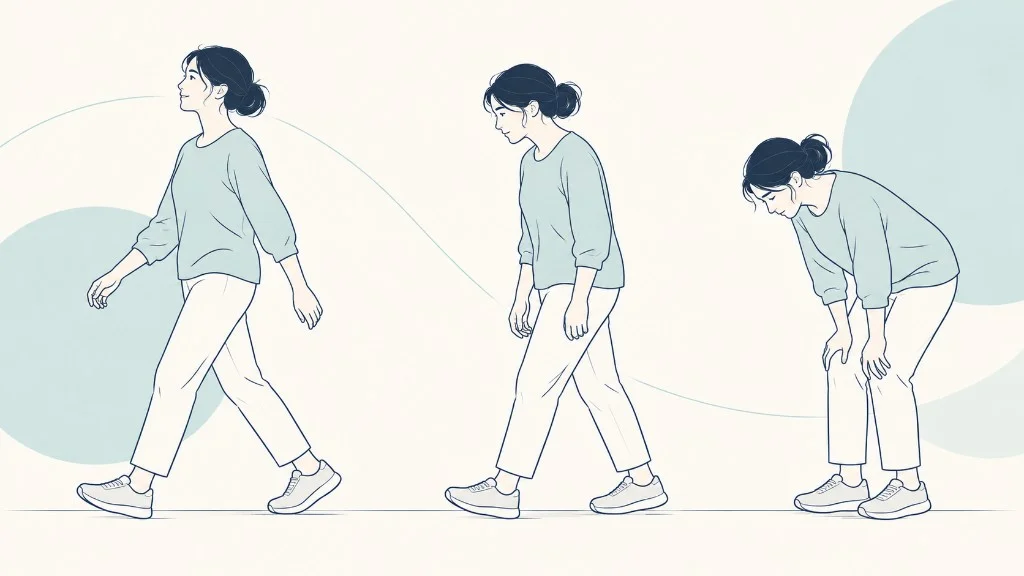
The parking lot is manageable. Halfway across the store, a leg grows heavy, or the low back starts to ache, and the walk back to the car is the part that fails. An hour later, in a chair, the same person may feel settled.
People call that whole sequence “pain after walking.” The phrase covers more than one pattern, and the differences are the part worth sorting.
What stops the symptoms, where they travel, and what else can limit a walk are three separate questions. A tight canal is one possible answer. The hip, blood flow, and tired muscles are others. This page stays on the sort.
What shows up on a walk is still a symptom
Pain, heaviness, or numbness that appears while you walk is a report about timing. Lumbar spinal stenosis is narrowing of the space that holds the spinal cord and the nerves, and that narrowing can squeeze them. The squeeze is a possible explanation for some walking limits. It is not the explanation for every back that aches after an errand, and the ache itself is not the diagnosis.
AAOS OrthoInfo describes what nerve pressure can feel like. People may or may not have back pain. Pressure on the nerves can cause burning pain, numbness, or tingling in the buttocks or legs.
That traveling nerve pain is called sciatica. Weakness, or a foot that slaps the ground, can occur when the pressure is greater. Not everyone has weakness. A walk that ends because of a sore back, with quiet legs and a foot that lands normally, is a thinner match for that description.
A 2022 review in JAMA describes clinical lumbar stenosis as a history of back and leg pain brought on by extension and relieved by flexion, then confirmed with imaging. Extension is the upright position that arches the lower back. Flexion is bending forward.
Walking and standing straight hold many people in extension long enough for symptoms to build. Sitting or leaning takes them into flexion. The history is the first half of that description.
Imaging is the second half. A sidewalk is neither half by itself.
The words “after walking” hide a second timing that should stay separate. Some people are fine while they move and then ache once they sit down. Some people are forced to sit because the symptoms are already building.
The second report is the one that lines up with a canal that is tight when the spine is upright. The first report can be joints or muscles that are tired of the job. Note whether the symptoms rose during the walk or waited until the walk was over.
A narrow canal on a picture, without this story, is a different finding. In a Framingham imaging study, narrowing was common and often had no symptoms. A scan that looks tight does not explain a walk you can finish without a limit.
A walk you cannot finish does not, by itself, mean the scan will look tight. The symptom and the image are read together later.
Sort the walk by what actually stops it
The useful split is what you have to do before the symptoms ease.
Some people stop walking, remain standing upright, and the leg settles. Some people can stand as long as they like and the legs stay heavy until they sit, lean on a cart, or bend forward. Those are different reports. They should not both be written down as “rest helps.”
AAOS describes the pattern that fits a tight canal in everyday language. People often feel better when they lean forward or sit. Standing straight or walking usually makes the pain worse.
Leaning forward can increase the space available for the nerves. Some people can ride a stationary bike, or walk while leaning on a shopping cart. Walking more than one or two blocks may bring on severe sciatica or weakness.
The block count is a familiar picture of a limit. It is not a distance you pass or fail. How a walking distance is used in clinic and in trials, as a description rather than a grade, is the subject of Walking Distance and Lumbar Spinal Stenosis: A Limit, Not a Grade.
The walking form of these nerve symptoms is often called neurogenic claudication. The legs ache, feel heavy, tingle, or weaken while you walk or stand, and flexion eases them. The JAMA review treats that kind of history as the start of a stenosis diagnosis, not the finish.
If your legs ease only when you sit or lean, say that. If they ease the moment you stop and stay upright, say that too.
The second report raises a question about blood flow in the legs. A calf that cramps while you walk and releases when you simply stand, without sitting and without leaning, is the comparison clinicians have in mind. No single detail separates nerve pain from a circulation limit perfectly.
The tendency is what you can actually report: which rest you needed, and how long it took. A person can have both problems.
Timing belongs in the same note. Symptoms that build over minutes of walking and ease over minutes of sitting are different from an ache that appears at the end of a long day and lingers through the evening. A limit that is similar from week to week is easier to read than one bad afternoon.
Hills can feel different from flat ground, because the lower back extends more in one direction than the other. Say which direction was harder.
What stops the walk
The rest that works is part of the history
Two walks can end at the same corner for different reasons.
Eases when you sit or lean
- Buttock or leg symptoms build while you walk.
- Standing still, fully upright, does not reset them.
- A cart, a bench, or a forward lean lets you continue.
- The legs, more than the back, are why you stop.
Eases when you simply stand still
- A calf cramp fades without sitting.
- Leaning adds little once walking has stopped.
- The feeling often stays in the calf.
- Blood flow belongs among the questions to ask.
These are tendencies to report, not names for the cause.
Where the feeling travels
An ache across the low back is not the same report as heaviness in both calves, numbness in a foot, or a burning line from the buttock toward the ankle. AAOS ties that burning, numb, or tingling spread to pressure on the nerves. Back pain alone can come from joints, or from muscles that are tired of holding you upright.
People with stenosis may or may not have much back pain. If the legs are the reason the walk ends, that fact matters more than how sore the back is.
One leg does not settle the question. Both legs are the usual picture of neurogenic claudication. One leg can still be a nerve under pressure.
It can also be one hip, one joint at the back of the spine, or a single nerve root. The side you feel it on is part of the history. It is not a diagnosis, and “both legs” is not a diagnosis either. If one leg is clearly worse, say which one, and say whether the other leg is quiet or only quieter.
Pain that sits in the groin, or stiffness when the hip has to turn or swing forward, puts the hip on the list. The hip can shorten a walk while the canal is not the problem. It can also do so in a person who already has a narrow canal on a scan.
How those sources are separated is covered in Is Your Lower Back Pain Coming From Your Spine or Your Hip?. If both regions speak up on the same outing, bring both. Do not drop the hip because an older report mentioned the spine.
Numbness, pain, and weakness are three reports. Numbness can be present when pain is mild. Weakness, or a foot that slaps, is what AAOS describes when pressure is greater, and it is not required for the walking pattern.
Many people stop because the legs feel heavy, while a strength test on another day looks ordinary. Write down what you notice on the walk. Do not substitute what you think an exam is supposed to find.
Other reasons the same walk gets short
Tired muscles are a real limit. A back that aches after carrying groceries, eases when you change position in any direction, and never sends symptoms into the legs can be fatigue, or joints that dislike a long time on your feet. The detail that pulls this story away from a tight canal is the quiet legs, plus a rest that works about the same whether you sit, lean, or simply stop. If every change of position helps about equally, say so.
Blood flow is the other limit that gets folded into “back pain after walking” when the complaint that actually stops you is the calf. The spine can be mildly sore from the way you stand, and the reason you halt can still be a cramp that releases when the walking stops. Mention the calf separately from the back.
Mention whether you had to sit. You do not have to decide the cause in the parking lot. You do have to keep the two feelings from becoming one vague sentence.
Standing and sitting compare these patterns in a different frame, including how a long stand differs from a long walk. That comparison is in Lower Back Pain When Standing vs. Sitting: What It Means. A person who is fine on a walk and miserable at a counter is not telling the same story as a person who fails at both.
Some changes should not be sorted at home across another week of errands. AAOS describes cauda equina syndrome as rare. It is numbness in the private area, loss of bowel or bladder control, or legs that lose strength so that walking fails.
That cluster needs prompt care. It is not a version of a walk that was shorter than yesterday.
| What you notice | What it leans toward | What it leaves open |
|---|---|---|
| Symptoms ease only after you sit or lean | A nerve-space story, including a canal that is tight when you stand straight. | Which level is involved, and whether the hip is also part of the limit. |
| Symptoms ease when you stand still, upright | A question about blood flow in the leg, especially if the calf is the site. | A spine problem that happens to be present at the same time. |
| Pain stays in the groin, or the hip will not swing | The hip as its own reason the walk is short. | A nerve or a joint problem on the same side. |
| The ache stays in the back, and the legs stay quiet | Muscles or joints that dislike a long time on your feet. | Stenosis, which usually shows itself in the buttocks or legs, not in back pain alone. |
How to describe the walk so a visit can use it
Four lines are enough when they are specific.
What you were doing when the symptoms started. Walking the dog, crossing a store, or climbing the ramp from the parking lot is more useful than “it happens when I am active.” If the way back is harder than the way out, say so. If a cart, a stroller, or a hill changes the outing, say which one, and say what changed: distance, leg heaviness, or only the ache in the back.
Where the symptoms go. Point to the place: low back only, one buttock, both calves, the groin, a numb patch in the foot. If the foot slaps or the ankle gives, put that on its own line, separate from pain. If the legs feel heavy and strength at home seems ordinary, say that too.
What turns the symptoms down, and how long that takes. “I stood at the corner and the calf eased” is different from “I had to sit on a bench before my legs would go again.” If standing still is enough, a tight canal is a less natural first reading.
If sitting or leaning is required, the canal belongs among the possibilities to test. Note whether the ease comes quickly or only after a long sit. The timing is part of the description. It is not a score.
What would make you stop treating this as a diary. New numbness in the private area, new trouble controlling bladder or bowel, or legs that suddenly will not carry you are emergency symptoms. New weakness that is clearly worse than last week belongs in a prompt call even when the full cluster is not present. A familiar limit that matches last month’s note can wait for the appointment you already have.
Bring the note. A clinician can then decide whether the story is strong enough to confirm with imaging, or whether the hip, the circulation, or a simpler muscle problem should be examined first. AAOS names X-rays, MRI (a picture of the canal and the nerves), and sometimes CT or a CT myelogram, which are other pictures of that anatomy.
Those pictures show structure. They do not replace the account of the walk. The questions to prepare for a visit are a place to hold the note. They do not turn a short outing into a procedure.
A description you can finish without naming the cause
A walk that brings on symptoms is information about timing. The sort is what makes you stop, where the feeling travels, and which other structures can set the same limit. A tight canal fits best when the legs are why you stop and sitting or leaning is what lets you start again.
Tired muscles, a hip that will not swing, and a calf that eases when you simply stand still are other stories, and they can overlap in one person. Imaging can support a history that already matches. It cannot stand in for the history.
If the legs are quiet, let the back pain be investigated as back pain. If the legs are the reason the walk ends, say what rest they required and where the feeling went. The name of the condition, if there is one, comes after an examination.
Frequently asked questions
If the pain starts only after I sit down, is that the same pattern?
No. Pain that waits until you are already in a chair is a different report from pain that builds while you walk and then eases when you sit. The second timing is the one that fits a canal tight in an upright posture. An ache that appears only after the walk is over can come from joints or from muscles that held you up for a long time. Write down which timing you actually have. Neither timing is a diagnosis by itself, and a single evening does not settle it.
Can blood flow and a spine problem limit the same walk?
Yes. A calf cramp that eases when you simply stand still can sit next to a back that aches for a separate reason. The two limits should be described separately: where the feeling is, and what kind of rest turns it down. No single detail separates them perfectly. A clinician can check both the legs and the back. Mentioning only the back, or only the word stenosis from an old scan, hides the split the visit needs.
Does a foot that slaps the ground mean I waited too long?
A foot that slaps, or a leg that gives, is a sign of greater pressure on a nerve, in the description used by the American Academy of Orthopaedic Surgeons. It is not required for a walking limit, and many people stop because of heaviness while strength on another day looks ordinary. New or clearly worsening weakness belongs in a prompt call. It is not proof that a particular operation is due, and it is not something to file as ordinary fatigue.
Should I write down the walks that went well?
Yes. A limit is easier to read when you also note the walks that were ordinary. If Tuesday's loop was fine and Thursday's ended at the same corner, say what differed: hills, a cart, a long stand before you started, or shoes. A string of similar limits is more useful than one bad afternoon. A string of easy walks matters too, because a scan taken during a good month can still show narrowing that is not explaining your days.
Is a shopping cart worth mentioning if I only use one sometimes?
Yes, if you can say what it changed. Leaning on a cart flexes the lower back, and that posture can leave a little more room for the nerves when the canal is already tight. If the legs are clearly easier with the cart, and not easier when you stand still, that belongs in the note. If you use the cart only to carry bags and the legs feel the same, say that instead. Occasional use is still a real observation.
Key takeaways
- Pain or heaviness that shows up on a walk is a symptom pattern. It is not, by itself, lumbar spinal stenosis or any other diagnosis.
- The useful split is what turns the symptoms off: sitting or leaning, versus simply standing still. Where the feeling travels matters just as much.
- The hip, blood flow, and tired muscles can shorten the same walk. A narrow canal is one possible fit when the legs are why you stop and flexion is the reset.
- Imaging can support a matching history. Narrowing on a scan is common in people without symptoms, and a comfortable walk is not explained by the picture alone.
References
- Lumbar Spinal Stenosis. OrthoInfo, American Academy of Orthopaedic Surgeons.
- Katz JN, Zimmerman ZE, Mass H, Makhni MC. Diagnosis and Management of Lumbar Spinal Stenosis: A Review. JAMA. 2022;327(17):1688-1699. 2022.
- Kalichman L, Cole R, Kim DH, et al. Spinal stenosis prevalence and association with symptoms: the Framingham Study. The Spine Journal. 2009. 2009.
Prepare questions for your consultation
Organize your symptoms, imaging, and treatment history into clear questions for a spine specialist. The questionnaire does not decide candidacy.