Many people notice that their back behaves differently depending on what they are doing. Some can sit through a long meal comfortably but struggle to stand in line at the pharmacy. Others feel fine walking but stiffen up after an hour at a desk.
These patterns are worth paying attention to. They are not a diagnosis, but they give you and your clinician a useful starting point.
This article explains why position changes back pain, what the two main patterns may suggest, which non-spine causes can look similar, and when a position-related pattern needs prompt attention.
Why position changes how your back feels
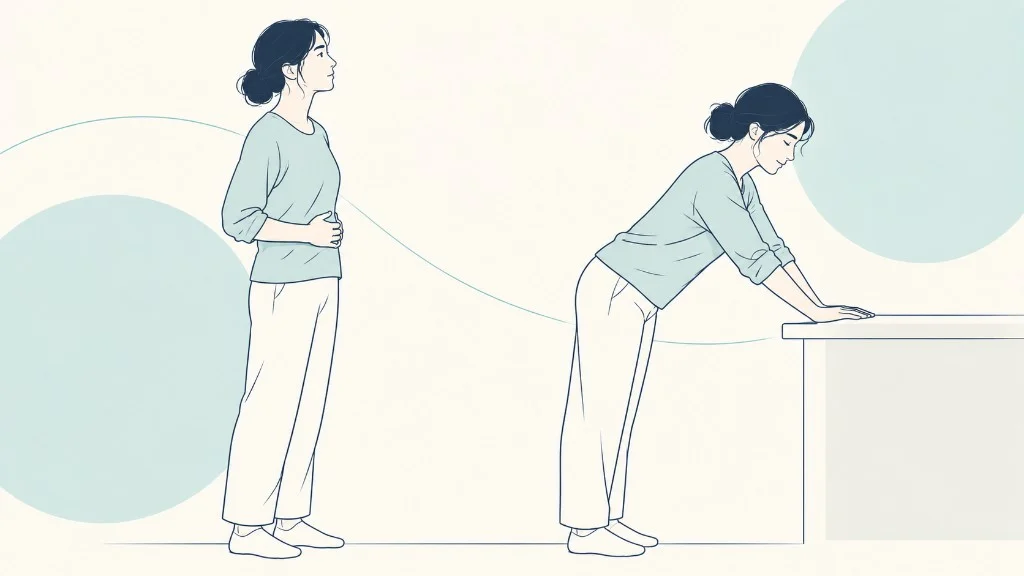
Your lower back, or lumbar spine, is not a fixed column. It changes shape with every posture. When you stand tall or lean backward, the lumbar spine moves into extension, meaning its natural inward curve deepens. When you sit, slump, or bend forward, it moves toward flexion, and that curve flattens.
These small changes matter because they alter three things at once:
- The space around the nerves. Bending forward slightly enlarges the openings that the spinal nerves pass through. Arching backward slightly reduces them. NIH’s overview of spinal stenosis describes this directly: the flexed position “opens up” the spinal column.
- The load on different structures. Extension shifts more load toward the facet joints at the back of the spine. Flexion shifts more load toward the discs at the front.
- Muscle demand. Standing still and sitting still both require muscles to hold a posture for a long time, which can cause fatigue-related aching regardless of what is happening in the joints.
Because the same movement changes several structures together, one posture can aggravate more than one possible source of pain. That is the main reason a position pattern points in a direction rather than to a single answer.
When standing makes it worse and sitting helps
When this pattern also involves the legs, it is most often linked to lumbar spinal stenosis, a narrowing of the spaces in the lower spine that hold the nerves. Stenosis usually develops gradually as discs lose height, facet joints enlarge with arthritis, and ligaments thicken. We cover the condition in detail in What Is Lumbar Spinal Stenosis?
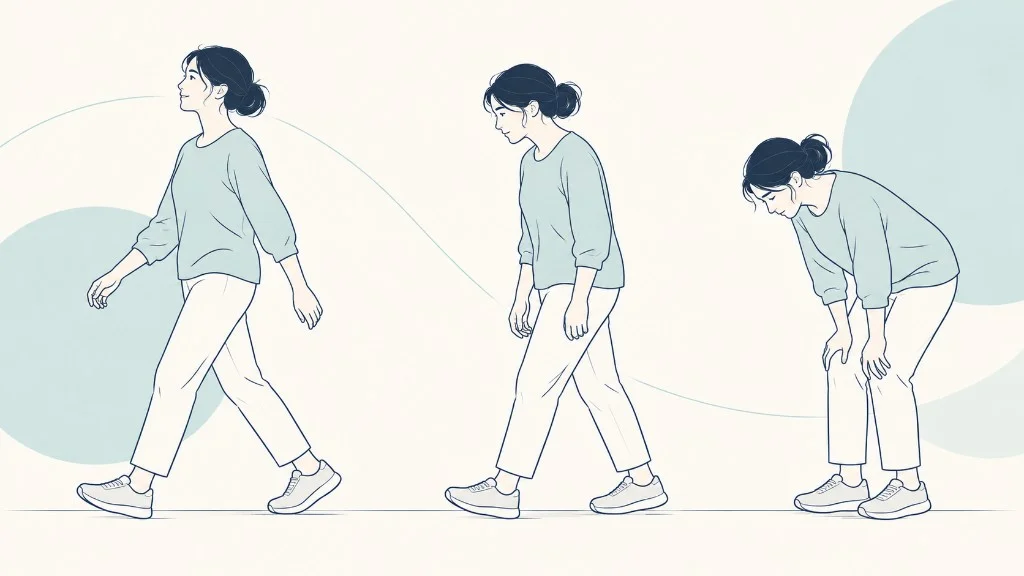
When stenosis compresses nerves, it can cause neurogenic claudication: pain, heaviness, numbness, tingling, or weakness in the buttocks and legs caused by pressure on nerves in the lower spine. It typically builds up with standing or walking and eases after sitting or bending forward for a few minutes. A 2022 review in JAMA describes the diagnosis as generally based on back and leg pain that is provoked by lumbar extension and relieved by lumbar flexion, then confirmed with CT or MRI. The same review estimates that the clinical syndrome affects approximately 11% of U.S. adults, with prevalence increasing with age.
Some everyday clues fit this pattern:
- You can walk farther when leaning on a shopping cart or walker.
- Cycling, which keeps you bent forward, is easier than walking the same distance.
- Standing at a sink or counter brings on heaviness in the legs that eases when you sit.
- Walking downhill, which tends to arch the back, feels worse than walking uphill.
The American Academy of Orthopaedic Surgeons notes the shopping cart and stationary bike observations specifically, and explains that leaning forward can increase the space available for the nerves.
Stenosis is not the only explanation for this pattern. Irritated facet joints can also hurt more in extension, and fatigued back muscles often ache after standing still. A useful distinction is that facet or muscular pain tends to stay in the back and upper buttock, while neurogenic claudication usually involves the legs.
Stenosis is also frequently associated with spondylolisthesis, where one vertebra has slipped forward on the one below. That condition is explained in What Is Spondylolisthesis?
When sitting makes it worse and standing helps
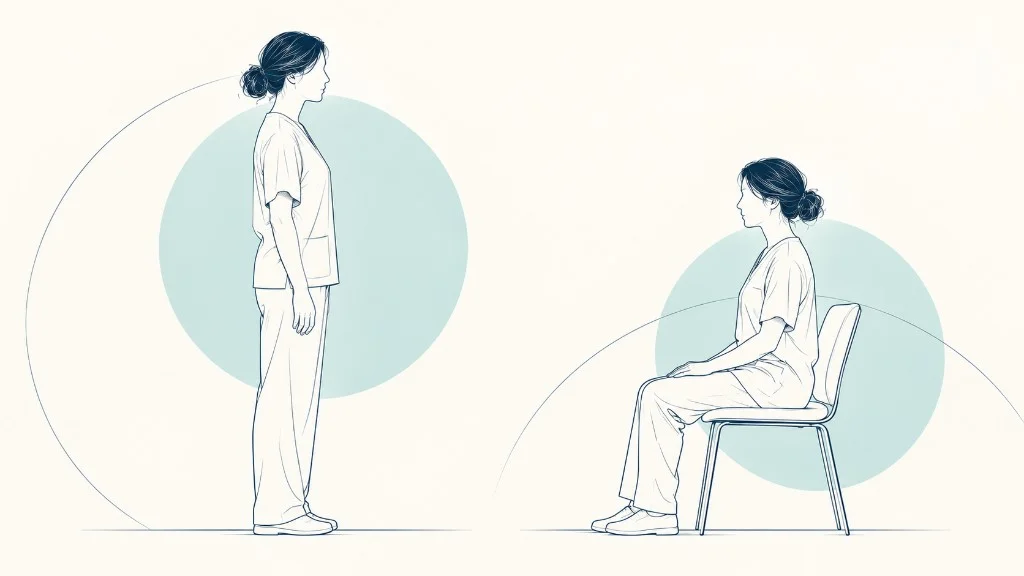
The reverse pattern, pain that builds during a long drive or a day at a desk and eases when you stand up and move around, is common and much less specific.
Clinicians may consider several possibilities:
- Disc-related pain. Flexion and sitting change how forces are distributed across the lumbar spine. In some people with disc-related pain, prolonged or slumped sitting may aggravate symptoms.
- Muscle and postural fatigue. Holding any posture for a long time can cause aching. Pain that eases quickly once you change position often fits this picture.
- Sacroiliac joint pain. The sacroiliac joints connect the base of the spine to the pelvis. Pain from these joints is usually felt low and to one side, and sitting on a hard surface or getting up from a chair can aggravate it.
- Hip problems. Stiffness when getting up after sitting is common with hip arthritis.
No sitting pattern reliably points to a single cause. It is also normal for people to have a mix: for example, a stiff, achy back after sitting and leg heaviness after standing. Describing both to your clinician is more helpful than trying to decide which pattern “counts.”
Is it your spine, your hip, or something else?
Several conditions outside the spine can produce symptoms in the lower back, buttock, and legs.
The hip
Hip osteoarthritis and lumbar spinal stenosis are both increasingly common with age, and their symptoms can be similar. A review of hip-spine syndrome in the Journal of the American Academy of Orthopaedic Surgeons notes that the two conditions often occur together, which makes it challenging to identify the main source of pain. The authors emphasize a careful history, physical examination, and selective testing to decide which problem to address first.
Features that lean toward the hip include pain in the groin or front of the thigh, pain when rotating the hip, difficulty putting on socks, and a limp. Features that lean toward the spine include pain that travels below the knee, numbness or tingling in the foot, and relief from bending forward.
Blood flow to the legs
Narrowed arteries in the legs can cause vascular claudication: cramping leg pain during walking that eases with rest. One commonly described difference is that vascular claudication usually eases when you simply stop and stand still, while neurogenic claudication often needs sitting or bending forward to settle. Weak foot pulses and skin changes can also point toward a circulation problem.
These patterns can help guide evaluation, but no single symptom reliably distinguishes vascular from neurogenic claudication. Telling them apart matters because the two conditions are evaluated and treated very differently.
Other contributors
Muscle strain, the sacroiliac joints, and, rarely, conditions such as infection, fracture, or tumor can also cause back pain. The warning signs below help identify when a serious cause needs to be ruled out.
Symptom pattern
What the position of your pain may suggest
Standing, sitting, and overlap point toward different examinations. The same position can come from more than one structure, so the pattern is a clue, not a diagnosis.
Worse with standing or walking
Especially when the legs feel heavy, numb, or painful, and sitting or leaning forward eases it. Lumbar stenosis is one possibility. Tired muscles and facet joints can look similar.
Worse with prolonged sitting
Less specific. Discs, sustained posture, muscles, and the hip or sacroiliac joints can all produce this pattern.
Can overlap
Hip arthritis and lumbar problems are both common with age. Groin pain, a limp, or stiffness turning the hip can point toward the hip even when the ache feels like the back.
A pattern is a clue for the examination. It does not name the cause by itself.
What a clinician may look at
Because posture patterns overlap, clinicians combine them with other information. The table below summarizes how common patterns are typically interpreted.
| Pattern you notice | What it may suggest | What clinicians may evaluate |
|---|---|---|
| Leg pain, heaviness, or numbness after standing or walking; eases with sitting or leaning forward | Nerve compression from lumbar spinal stenosis (neurogenic claudication) | Walking tolerance, leg strength and reflexes, foot pulses to exclude a circulation problem, MRI or CT if treatment decisions depend on it |
| Back-only ache after standing still that eases with sitting | Facet joint or muscular pain | Pain with backward bending, tenderness, posture and core strength |
| Pain that builds with prolonged sitting and eases with standing or walking | Non-specific; may involve discs, muscles, or sustained posture | Movement testing, sitting habits, response to activity and exercise |
| Groin or thigh pain, stiffness getting up, pain turning the leg | Hip joint problems, alone or alongside a spine problem | Hip range of motion, hip X-rays, sometimes a diagnostic hip injection |
| Low, one-sided buttock pain when sitting or rising | Sacroiliac joint involvement | Provocation tests of the sacroiliac joints, pattern of tenderness |
A typical evaluation starts with questions: where the pain is, where it travels, what makes it better or worse, how far you can walk, and whether you have numbness, weakness, or balance changes. The examination may include checking strength, sensation, reflexes, hip movement, and pulses in the feet.
Imaging is not always the first step. When it is used, it has an important limitation: many age-related changes appear in people with no pain at all. A systematic review in the American Journal of Neuroradiology pooled imaging data from 3,110 people without back pain.
Disc degeneration was present in an estimated 37% of 20-year-olds and 96% of 80-year-olds, and disc bulges rose from 30% to 84% across the same age range. The authors concluded that many of these findings are likely part of normal aging and must be interpreted in the context of a person’s symptoms.
That is why a clinician may describe an MRI finding as “consistent with” your symptoms rather than as proof of their cause.
When position-related pain needs prompt attention
Most position-related back pain is not an emergency. A small number of symptoms, however, can signal severe nerve compression or another serious problem and should not wait for a routine appointment.
Seek urgent medical care if you notice
- New difficulty controlling or emptying your bladder or bowels
- Numbness in the groin, genitals, or inner thighs (sometimes called saddle numbness)
- Leg weakness that is severe or getting worse quickly, such as a new foot drop
- Back pain after a significant fall or accident
- Severe back pain with fever or feeling generally unwell
The first three can be signs of cauda equina syndrome, a rare condition in which the bundle of nerves at the base of the spine is severely compressed. The AAOS describes it as a medical emergency that may require prompt surgery. NIH similarly notes that people with more severe stenosis may develop bowel, bladder, or sexual function problems.
Less urgent, but still worth prompt evaluation, is a steady decline in how far you can walk, or numbness and weakness that are gradually spreading.
Turning your pattern into useful information
Describing your symptoms clearly is one of the most useful things you can do before a visit. A few specifics tend to help most:
- Positions and triggers. Which positions make it worse, which make it better, and how quickly.
- Distance and time. Roughly how far you can walk or how long you can stand before symptoms begin, and how long they take to settle. Pain that shows up on a walk, and how to sort it from a hip or a circulation limit, is covered in Lower Back or Leg Pain After Walking: How to Sort the Cause.
- Where it travels. Back only, buttock, thigh, below the knee, or into the foot; one side or both.
- Nerve symptoms. Numbness, tingling, heaviness, weakness, or balance changes.
- What you have tried. Physical therapy, medications, injections, and how each affected you.
If you are preparing for a specialist appointment, our candidacy questionnaire can help you organize this information and the questions you want to ask. It does not decide whether any treatment is right for you, but it can make the conversation more focused.
A clear description of how your pain responds to position, combined with a careful examination and, when needed, imaging interpreted in context, gives you and your clinician the best chance of finding what is driving it.
Frequently asked questions
Why does my lower back hurt when I stand but feel better when I sit?
Standing upright slightly arches the lower back. In people whose spinal canal is already narrowed, that position can reduce the space around the nerves further, and sitting or bending forward can restore some of it. That is why this pattern is linked to lumbar spinal stenosis, especially when standing or walking also brings on leg pain, heaviness, or numbness. Tired back muscles and irritated facet joints can produce a similar pattern, so a clinician will usually look at where the pain travels, whether the legs are involved, and what the examination shows.
Is back pain that gets worse when sitting a sign of a disc problem?
Sometimes, but not reliably. Prolonged sitting keeps the lower back in one position for a long time, and some people with disc-related pain notice it most then. Muscle fatigue, sitting posture, and hip or sacroiliac joint problems can do the same. Many people have more than one contributor.
Can hip arthritis feel like lower back pain?
Yes. Hip arthritis often causes pain in the groin or front of the thigh, but it can also be felt in the buttock, which people often describe as low back pain. Stiffness when rotating the hip, pain getting in and out of a car, and a limp can point toward the hip. Because hip arthritis and lumbar spinal stenosis are both common with age, a person can have both, and clinicians sometimes need an examination, imaging, or a diagnostic injection to decide which is driving symptoms.
Should I get an MRI if my back pain changes with position?
Not necessarily. Position-related back pain without leg symptoms or warning signs often improves without imaging. MRI becomes more useful when symptoms persist, when there are nerve-related leg symptoms, when surgery or an injection is being considered, or when a clinician suspects a serious cause. MRI also shows many age-related changes in people without pain, so results need to be interpreted alongside your symptoms and examination rather than on their own.
What should I track before seeing a clinician about position-related back pain?
Note which positions and activities make the pain worse or better, how long you can stand or walk before it starts, whether pain, numbness, or heaviness travels into one or both legs, and how quickly it settles when you sit or lean forward. Record any weakness, balance changes, or bladder or bowel changes. A short written summary, including treatments you have already tried, often makes an appointment more productive than trying to remember details on the spot.
Key takeaways
- Leg pain, heaviness, or numbness that builds with standing or walking and eases with sitting or leaning forward is the classic pattern of lumbar spinal stenosis; back pain alone is much less specific.
- Pain that worsens with prolonged sitting is less specific and may involve discs, muscles, or the hip and sacroiliac joints.
- Hip arthritis and lumbar spine problems often coexist in older adults and can be hard to tell apart without an examination.
- Imaging findings such as disc degeneration are common in people without pain, so MRI results are interpreted alongside symptoms.
- New bladder or bowel problems, saddle numbness, or rapidly worsening leg weakness need urgent medical assessment.
References
- Katz JN, Zimmerman ZE, Mass H, Makhni MC. Diagnosis and Management of Lumbar Spinal Stenosis: A Review. JAMA. 2022;327(17):1688-1699. 2022.
- Spinal Stenosis. National Institute of Arthritis and Musculoskeletal and Skin Diseases (NIAMS), National Institutes of Health.
- Devin CJ, McCullough KA, Morris BJ, Yates AJ, Kang JD. Hip-spine syndrome. Journal of the American Academy of Orthopaedic Surgeons. 2012;20(7):434-442. 2012.
- Brinjikji W, Luetmer PH, Comstock B, et al. Systematic literature review of imaging features of spinal degeneration in asymptomatic populations. American Journal of Neuroradiology. 2015;36(4):811-816. 2015.
- Lumbar Spinal Stenosis. OrthoInfo, American Academy of Orthopaedic Surgeons.
Prepare questions for your consultation
Organize your symptoms, imaging, and treatment history into clear questions for a spine specialist. The questionnaire does not decide candidacy.