Ask someone how far they can walk, and the answer sounds like a measurement. Two blocks. The mailbox and back.
Once around the grocery store if there is a cart. The number is useful only as a description of a limit. It does not grade lumbar stenosis, and it does not tell anyone that they passed or failed.
Lumbar spinal stenosis is narrowing of the space that holds the spinal cord and the nerves, which can squeeze them. How far a person gets before symptoms rise is one way to talk about that squeeze when it is actually causing trouble. The distance is the symptom report. The narrowing, if it is there, is a finding that still has to match.
A distance describes a limit, not a grade
People reach for a number because the limit is concrete. The dog walk ends at the same corner. The office is fine, and the walk from the car is not.
That concreteness is the value. It tells a clinician what the day will and will not hold. It does not translate into the words mild, moderate, or severe on an imaging report.
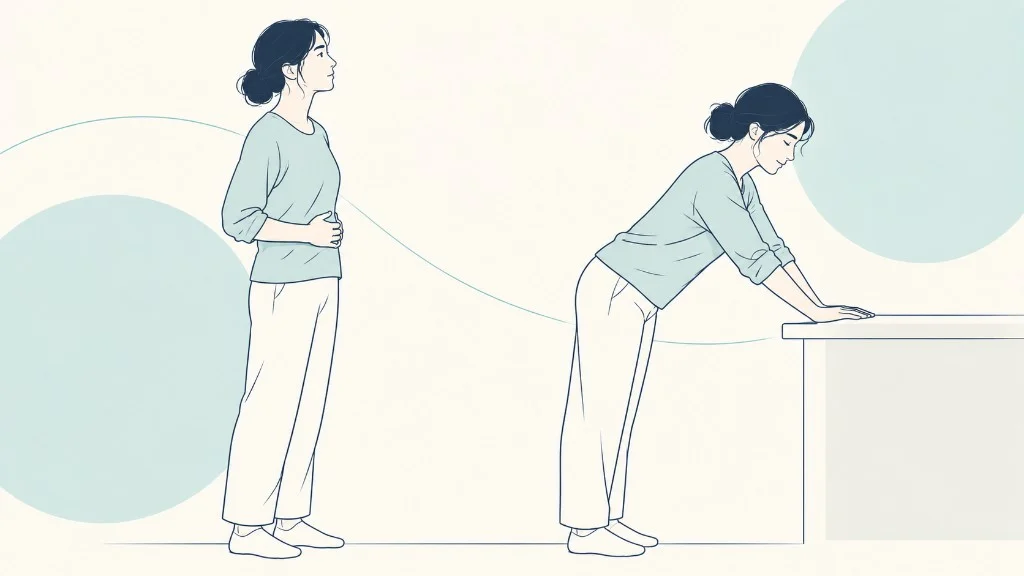
A 2022 review in JAMA describes clinical lumbar stenosis as a history of back and leg pain brought on by extension and relieved by flexion, then confirmed with imaging. Extension is standing or walking upright. Flexion is bending forward.
The distance you can cover while extended is part of that history. It is the “brought on by” half, stated in blocks or minutes. Confirmation with imaging is a later step. How images are read beside symptoms, including why a severe-sounding report is not the same thing as a severe day, is covered in Mild vs. Moderate vs. Severe Lumbar Spinal Stenosis: Key Differences.
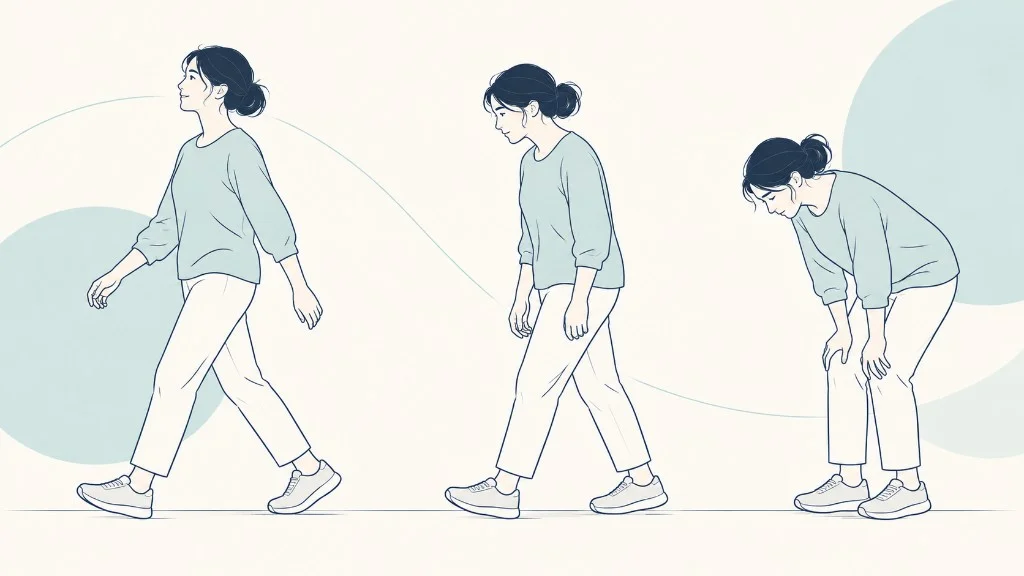
The walking form of the symptoms is often called neurogenic claudication: aching, heaviness, tingling, or weakness in the legs that builds with walking or standing and eases when you sit or lean. A short distance can be how that pattern shows up. A short distance can also be a hip, a calf that wants you to stand still, or muscles that are simply done.
Sorting those lookalikes is the job of Lower Back or Leg Pain After Walking: How to Sort the Cause. This page starts after that sort, when the question is what to do with the distance itself.
A scan that looks narrow does not assign you a walking distance. In a Framingham imaging study, narrowing was common and often had no symptoms. Someone who walks a familiar long loop, and whose pictures show a tight canal, does not have a “failed” distance.
Someone who stops early, and whose pictures are roomy, does not have a distance that creates stenosis. The figure and the film answer different questions. Putting them on one scale is how a symptom report gets mistaken for a grade.
One or two blocks is a picture, not a cutoff
AAOS OrthoInfo gives a picture many people recognize. Walking more than one or two blocks may bring on severe sciatica or weakness. Sciatica here means burning pain, numbness, or tingling in the buttocks or legs from pressure on a nerve. The sentence sits next to other familiar pictures on the same page: feeling better when you lean forward or sit, feeling worse when you stand straight or walk, and being able to ride a stationary bike or lean on a shopping cart.
Read as a group, those lines describe a limit that shows up in ordinary neighborhoods. They are not a ruler. You do not develop stenosis at block three, and you do not clear it by reaching block four.
Someone whose symptoms start at the end of a long flat path still has a limit worth describing. Someone who is stopped inside a single block is not in a separate disease because the number is smaller. The number is the person’s report of when symptoms become hard to continue through.
AAOS also says people may or may not have back pain, and that not everyone has weakness. A distance cut short by leg heaviness, with a strong foot and a quiet back, still counts as a walking limit. A distance cut short by back pain alone, with quiet legs, is a less specific report.
The block count cannot repair a story that never included the legs. Write the reason you stopped next to the distance, or the distance will be asked to mean too much.
The same page says leaning forward can increase the space available for the nerves. That is why the distance with a cart, and the distance upright, can be two different numbers on one afternoon. Report both if both are true.
Averaging them into one “typical” block count throws away the comparison that makes the history recognizable. The upright number is not more official than the cart number. They are two conditions.
Symptom report
What a walking distance can and cannot say
The number is a description of a limit under a stated condition.
It can describe
- How far you get before leg symptoms make you stop.
- Whether a cart, a lean, or a bike changes that distance.
- Whether the limit is steady from week to week.
- How much of the day the limit takes over.
It cannot grade
- Mild, moderate, or severe narrowing on a scan.
- Whether the canal is the cause.
- A pass line for diagnosis or for surgery.
- Whether the canal has opened because the walk got longer.
One or two blocks is a familiar picture, not a cutoff.
How a clinic uses the distance
A useful clinical question is not “how far can you walk?” in the abstract. It is how far, on what surface, in what posture, and what makes you stop. The answer “two blocks” means something when you add that the legs get heavy, that standing still does not reset them, and that the same two blocks have been the limit for months. Without those clauses, two blocks could be a hip, a choice to rest, or a day of poor sleep.
Clinicians also use the distance to hear the impact, which is a different use from naming the disease. Difficulty walking for extended periods is one of the limits AAOS names when it describes surgery as generally reserved for poor quality of life from pain and weakness. The distance is one way that difficulty shows up in a life: the errands you skip, the seats you plan, the routes you no longer start.
A person who can walk a long way and is miserable for other reasons, and a person who stops at a block and has arranged life around that stop, are not separated by a single threshold. Quality of life is the frame. The block count is evidence inside it, not the frame itself.
The order of the workup stays the one in the JAMA review. History first, including this distance. Imaging second, to confirm.
How that order is carried out, and which pictures are used, is the subject of How Is Lumbar Spinal Stenosis Diagnosed? MRI and Clinical Signs. AAOS names X-rays, MRI, and sometimes CT or a CT myelogram as ways to confirm anatomy.
MRI is a scan that shows the canal and the nerves. A CT scan stacks X-ray slices. Those studies can show a narrow level that might explain a short walk.
They do not contain the walk. Flexion-extension X-rays, taken bending forward and backward, can show too much motion between bones, called spondylolisthesis, a slip of one vertebra on the next. A slip is a separate finding. It is not what the block count measures, and it is not automatically the reason the walk is short.
Bring a distance you can stand behind. A familiar loop is better than a guess made in the waiting room. If you have not tested the limit lately because you stopped trying, say that.
“I do not know, because I drive now” is an honest report. It should not be converted into a number you hope sounds serious enough.
How a trial used pain and function
Research also needs a way to talk about walking, and it rarely does that with a pass mark of one or two blocks. The Spine Patient Outcomes Research Trial, usually called SPORT, compared surgery with nonsurgical care for lumbar stenosis without spondylolisthesis. The New England Journal of Medicine report is about pain and function, not about a distance you had to beat.
Many people in that trial crossed over between groups, so the randomized comparison is hard to read cleanly. A randomized comparison assigns people by chance and tries to keep them in the assigned group. Crossover means many received the other care instead.
In the as-treated analysis, which follows the care people actually received, surgery was associated with better pain and function at two years. That analysis is not the same as a perfect randomized result. It is one reading of a trial in which people changed groups.
Function in that setting includes how limited someone is in daily activity. Walking is part of daily activity for most people in this condition. The findings used here do not include a block count that separates a good result from a poor one.
Quoting the trial as if it scored one or two blocks would mix AAOS’s patient-education picture with a different study. The trial also enrolled people who were being treated for stenosis, not everyone with a short walk from any cause. A hip, a circulation limit, or tired muscles were not the question it answered.
The trial does not turn a mailbox walk into a score, and it does not promise a longer distance after an operation or after nonsurgical care.
| How it is stated | What it captures | What it does not capture |
|---|---|---|
| Blocks, or a landmark you know | A repeatable personal limit on a real route. | The grade of narrowing, or a cutoff used to diagnose stenosis. |
| The same route with a cart, then without | Whether flexion changes the distance. | Proof that the canal is the cause. |
| Pain and function in a trial such as SPORT | How limited people were, compared over time, with a stated analysis. | A perfect randomized result, or a pass mark in blocks. |
| Words such as mild or severe on an MRI | How the picture was described. | How far that person can walk. Narrowing is often present without symptoms. |
What changes the number without changing the canal
The distance moves for reasons that leave the bones where they were. Flexion is the clearest one in the AAOS description. A cart, a walker, or a stationary bike can make a longer outing possible because leaning forward may give the nerves a little more room.
Stand upright and the limit can return on the same day. The canal did not widen and then narrow again over an hour. The posture changed.
A bad afternoon is another mover. Sleep, a hill, a heavy bag, or a long stand before you start can shrink one walk without announcing a new disease. The figure that helps is the one that repeats under similar conditions.
If you only record the worst day, the limit will look steeper than the week. If you only record the day you used a cart the whole time, the limit will look milder than the upright life you actually live.
Nonsurgical care does not improve the narrowing, AAOS says, but many people report symptom relief. A longer comfortable walk after a change in how you move, or after other care your clinician directs, is a change in the report. It is not evidence the canal opened.
The reverse is also true. A shorter walk does not, by itself, prove the canal tightened on a schedule. It is a reason to describe what else changed: weakness, the type of rest you need, or a new pain in the groin or the calf.
Weakness deserves its own line beside the distance. AAOS notes that a foot that slaps, or loss of strength, can occur when nerve pressure is greater, and that not everyone has weakness. Two people who both stop at two blocks are not in the same situation if one has a foot that newly slaps and the other has heavy legs and ordinary strength.
The distance is shared. The nerve finding is not. Do not let the number swallow that difference.
Some changes are not a distance to recheck next weekend. Numbness in the private area, loss of bowel or bladder control, or legs that lose strength so walking fails are the rare cluster AAOS calls cauda equina syndrome. That needs prompt care.
It is not a shorter version of a familiar block count. A familiar limit that matches last month can be discussed at a planned visit.
How to record a distance so it stays a report
Keep the note small and repeatable.
State the condition. Flat sidewalk, store aisles, a hill, with a cart, or on a stationary bike. One number for all of those is not one number.
State why you stopped. Leg heaviness, calf cramp that eased when you stood still, groin pain, or back ache with quiet legs. The reason is what stops the distance from being mistaken for a grade.
State how you reset. Sitting, leaning, or standing upright. The reset is the other half of the stenosis history in the JAMA description. A distance without a reset is an unfinished report.
State whether strength changed. A foot that slaps, a knee that buckles, or strength that feels the same as last month. New weakness is not a footnote to the block count.
Bring that note instead of a single impressive or discouraging number. The questions to prepare for a visit can hold it. They do not score the walk, and they do not turn one or two blocks into a decision. The distance is allowed to stay what it is: a clear description of a limit, under conditions you actually named, waiting to be read next to an exam and, when the story fits, next to an image.
Frequently asked questions
If I can walk farther on some days, which distance counts?
Both, if you can say what differed. A single best day and a single worst day are weaker than the distance that shows up on ordinary days. Note whether a cart, a hill, a long stand beforehand, or a recent sit changed the number. Clinicians are listening for a repeatable limit, not for a personal record. A wide swing from day to day is still information. It means the figure needs a sentence attached, not that the question was pointless.
Does a longer walk mean the canal got wider?
No. A change in how far you can go is a change in the symptom. The American Academy of Orthopaedic Surgeons states that nonsurgical care does not improve the narrowing, even when people report relief. Leaning forward can increase the space for the nerves while you are in that posture, which is why a cart or a bike may stretch the same outing. When you stand up straight again, that temporary room is not a new canal. Feeling better on Tuesday does not rewrite the anatomy.
Is one block a reason to talk about surgery?
Not by the block count alone. AAOS generally reserves surgery for poor quality of life from pain and weakness, including difficulty walking for extended periods. A short familiar route can be part of that picture. It is not a pass line, and a longer route is not a promise that an operation is off the table for someone whose days are still ruled by pain or weakness. The distance describes impact. The decision uses the whole history, the exam, and the images.
Why ask about a stationary bike if the topic is walking?
Because the contrast is part of the symptom report. Some people with a tight canal can ride a stationary bike, or walk while leaning on a cart, and still be limited when they walk upright. The bike keeps the lower back flexed. Upright walking holds it extended. If the bike is easy and the sidewalk is not, that difference belongs next to the distance. If both are hard, or the bike was never tried, say that too. The bike is not a test you are required to pass.
Can I use minutes instead of blocks?
Yes. Blocks, minutes, a landmark, or a loop you already know are all ways to describe the same limit. Pick the version you can repeat honestly. A clinic hallway is one sample of one day, not a grade of the canal. Minutes on flat ground are different from minutes on a hill or in a store where you also stand and reach. Say which surface you mean. The unit matters less than using the same unit the next time you report.
Key takeaways
- Walking distance describes how limited a person is. It is not a mild, moderate, or severe grade of stenosis, and it is not a pass-fail test.
- AAOS uses one or two blocks as a familiar picture of when severe leg pain or weakness may appear. That picture is not a diagnostic cutoff and not a surgical threshold.
- Trials can use pain and function, which include daily limits such as walking, as outcomes. The SPORT as-treated finding is not a perfect randomized result and not a distance score.
- A longer walk does not mean the canal opened. Narrowing on a scan can also exist in people whose walking distance is not limited.
References
- Lumbar Spinal Stenosis. OrthoInfo, American Academy of Orthopaedic Surgeons.
- Katz JN, Zimmerman ZE, Mass H, Makhni MC. Diagnosis and Management of Lumbar Spinal Stenosis: A Review. JAMA. 2022;327(17):1688-1699. 2022.
- Weinstein JN et al. Surgical versus Nonsurgical Therapy for Lumbar Spinal Stenosis. The New England Journal of Medicine. 2008. 2008.
- Kalichman L, Cole R, Kim DH, et al. Spinal stenosis prevalence and association with symptoms: the Framingham Study. The Spine Journal. 2009. 2009.
Prepare questions for your consultation
Organize your symptoms, imaging, and treatment history into clear questions for a spine specialist. The questionnaire does not decide candidacy.