Reports often stack the words. Spondylolisthesis. Moderate to severe stenosis.
The stack feels like two diseases that found each other. In the common degenerative pattern it is one motion with two consequences: a vertebra has crept forward, and the canal in front of its back portion has less room. The leg symptoms people notice are usually from that room, not from the percent of the slip.
What stenosis feels like on a walk is in What Is Lumbar Spinal Stenosis? What a slip is, graded and typed, is in What Is Spondylolisthesis? This article is why the two show up on the same page, and what that should not automatically decide.
Why a degenerative slip narrows the canal
The pars, the small bone bridge at the back of the vertebra, is intact in a degenerative slip. When the disc has lost height and the facet joints have worn, the whole vertebra, body and back portion together, can slide forward. The canal is the space in front of that back portion.
Slide the back portion forward and the space shrinks. Ligament and joint overgrowth, the usual stenosis ingredients, are often there too. StatPearls treats degenerative spondylolisthesis and canal narrowing as linked for this geometric reason. The typical level is L4-L5, in older adults, more often women.
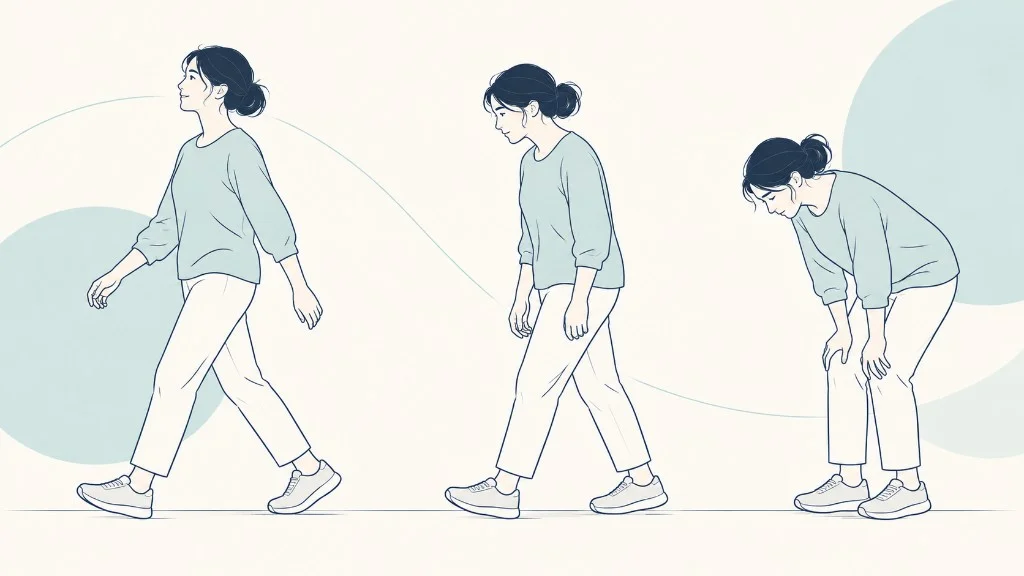
The symptom that matches this geometry is the stenosis symptom. Legs that grow heavy or numb over a predictable walking time, and ease when you sit or lean forward. NIAMS describes that pattern.
A grade 1 slip is enough to participate in it. The grade does not have to be dramatic for the canal to be symptomatic, and a dramatic word on the stenosis line does not prove the slip is what hurts. The match still has to be made.
Comparison
One anatomy, three labels
A degenerative slip, a crowded canal, and a walking limit can sit on the same level. They are not one diagnosis, and the walking limit can be missing when the first two are present.
The slip
A forward position of the vertebra on a standing X-ray. This is the spondylolisthesis.
The crowded canal
Less room for the nerve roots, often because that same vertebra's back portion moved forward. This is the stenosis.
The walking limit
Leg symptoms that build with walking and ease with sitting. This is what treatment is for. It can be missing even when the other two are present.
Fusion is a possible response to motion and to the decompression being planned. It is not the automatic response to seeing all three.
Why an isthmic slip is a different combination
If the pars is broken, the body of the vertebra can move forward while part of the posterior bone stays behind. The central canal is not squeezed in the same way. The nerve root leaving through the foramen is the more typical victim.
People then get a one-sided root pattern more often than the bilateral walking heaviness of central stenosis. Calling both situations “spondylolisthesis with stenosis” hides the difference that matters for where a decompression would have to work.
If you do not know whether the pars is intact, that is the next question, before any plan. The type comparison is in Degenerative vs. Isthmic Spondylolisthesis.
What the studies actually disagreed about
The North American Spine Society’s guideline, drawing on research through May 2013, suggests that decompression with fusion improves outcomes compared with decompression alone for people who have symptomatic stenosis and degenerative spondylolisthesis. The same summary says that for a symptomatic single-level slip under 20 percent, without foraminal stenosis, decompression that preserves midline structures gives equivalent outcomes. Both are fair-quality, grade B statements. They are not a single rule, and they predate two better-known trials.
The SLIP trial studied 66 people aged 50 to 80 with stable grade 1 degenerative spondylolisthesis and stenosis. Adding fusion produced a larger gain on a physical-health quality-of-life score at two years, 15.2 versus 9.5 points, which the authors considered meaningful, and the difference lasted out to four years. Disability scores did not differ significantly at two years. Another operation occurred in 14 percent of the fusion group and 34 percent of the decompression-alone group over as long as four years.
The Swedish Spinal Stenosis Study studied 247 people aged 50 to 80 with one- or two-level stenosis, including 135 with degenerative spondylolisthesis. Fusion did not improve disability or walking distance at two years, and clinical results were not significantly different at five years, with or without a slip. Operations were longer, blood loss and cost were higher, and hospital stays averaged 7.4 days versus 4.1.
Read together, the trials say the combination does not have one surgical answer. They do not say fusion never helps, and they do not say decompression alone is always enough. They were different populations and different operations.
Quoting only SLIP, or only Sweden, is how this topic gets turned into a slogan. What fusion is, as a procedure, is explained in What Is Lumbar Spinal Fusion? The study context is part of why our clinical evidence page exists: to keep a result attached to the people who were studied.
| Statement | What it can mean | What it does not settle |
|---|---|---|
| Degenerative slip plus central stenosis | A common single anatomy, often at L4-L5 | That your walk is limited, or that fusion is required |
| Isthmic slip plus foraminal narrowing | A root crowded at its exit, a different target | That you also have the classic bilateral walking syndrome |
| Both words, no leg symptoms | Imaging findings that may be incidental | A reason to operate on a picture |
| Both words, and a clear walking limit | The situation the trials enrolled, if the slip is degenerative and the level matches | Which operation, until you have heard that the trials disagree |
What to ask when both words are already on the page
Ask which type of slip, whether the pars is intact, and which space is tight: center, lateral recess, or foramen. Ask whether that space matches the leg that hurts. Ask whether bending films show motion.
Ask, if surgery is offered, what would be removed and why fusion would or would not be added, with the two trials named rather than a single percentage. A percentage that blends quality of life, disability, reoperation, and satisfaction into one “success” is not a result these papers reported.
You can live with both labels and a walk you accept. You can also reasonably discuss decompression when the walk is unacceptable and the images match. The combination is an explanation.
It is not a verdict. Bring the walking minutes. They are the third label, and they are the one treatment can be judged against.
Care that does not start in the operating room
Both labels still get a non-surgical trial when strength is stable and there is no urgent nerve deficit. The trial looks like stenosis care if the symptom is a walking limit: shorter walks, a posture that eases the legs, and therapy aimed at that distance. It looks like ordinary back care if the symptom is aching without a distance limit.
Medicines, if any, are chosen for you. An injection can quiet a root for a while and does not stabilize a slip or open a canal permanently.
Judge the trial by the minutes, not by a repeat adjective. A later MRI that still says stenosis and still says grade 1, after the walk has improved, is a success of symptom care. A later MRI that looks the same, after the walk has not improved and you cannot accept the limit, is a reason to discuss decompression.
The images did not fail. They were not the target. How long to continue before that discussion is a decision you make with the clinician, not a number this article should invent.
How the two trials get misquoted
SLIP is the trial that sounds like “fusion wins,” and it was small, limited to stable grade 1 degenerative slips with stenosis, and its clearest separations were a quality-of-life score and later reoperation, not the disability questionnaire at two years. Sweden is the trial that sounds like “fusion adds nothing,” and it was larger, included people with and without a slip, and found no clinical gain from fusion at the cost of a bigger operation. People on forums quote one number from one paper and drop the population. The population is the result.
If your slip is isthmic, neither trial enrolled you. If your slip is grade 3, neither trial enrolled you. If you have no walking limit, you are not in the symptomatic stenosis group those operations were for.
Place yourself before you borrow a conclusion. The clinical evidence page is there so a result stays attached to its study. Use it that way.
A clinician who can say which trial, if either, resembles you is having the right conversation. A clinician who offers a single success figure for “slip plus stenosis” is flattening papers that refused to be flat.
Take the walking minutes to every visit that uses both words. If the minutes are acceptable and strength is stable, you are allowed to stop collecting opinions for a while. If the minutes are not acceptable, ask the decompression question before the fusion question: what space would be opened, and does it match the legs?
Fusion is a second question about whether that opening, plus the slip you already have, would leave the level too mobile. Some people need both questions answered yes. Some need only the first.
Some need neither, because the legs are not actually limited by this level. The combination on the report cannot tell those people apart. The exam can. Until it has, both labels are a description you can carry without turning them into a date for surgery.
One practical split helps at home. On days the legs limit the distance, you are dealing with the stenosis half, and the slip is in the background as a reason the canal is tight. On days the back aches and the distance is fine, you may be dealing with joints and discs, and the canal is not the day’s problem.
Treating every day as if both halves were flaring leads to too much rest, or to a premature surgical story. Note which half showed up. Over a month the pattern is usually obvious, and it is the pattern a clinician can use.
A pattern that is only “my back is bad” is too blunt for two diagnoses that do not always speak on the same day. Bring the split to the appointment. It gives the clinician something more useful than a pair of labels, and it keeps the plan attached to the half that is actually limiting you this month.
That half can change. The labels do not have to. Write down which half limited you, so the next visit starts from the week you lived rather than from the two words on the report.
Frequently asked questions
Does every spondylolisthesis cause stenosis?
No. A degenerative slip, with an intact pars, often narrows the central canal, which is why the two labels appear together so often in older adults. An isthmic slip, with a broken pars, more often affects the exit path of one nerve root, which is a different kind of crowding. Some slips of either type cause no symptoms and no meaningful nerve compression. The MRI has to show a tight space that matches the legs. The word slip on an X-ray is not stenosis by definition.
If I have both, do I need a fusion?
Not by the combination alone. A 2016 North American guideline suggested fusion plus decompression for symptomatic stenosis with degenerative spondylolisthesis, and also described situations under 20 percent slip, without foraminal stenosis, where decompression that keeps the midline structures did as well. Two randomized trials published around then disagreed with each other about fusion's added benefit. One was restricted to stable grade 1 degenerative slips. The other included stenosis with and without a slip. Your images and your walking limit have to be placed in that disagreement, not collapsed into 'both diagnoses, therefore fusion.'
Can the stenosis be treated and the slip left alone?
Sometimes. Decompression takes pressure off the nerves. Whether the level then needs to be stabilized depends on how much the slip already moves, how much of the stabilizing bone and joint would be removed, and the type of slip. That is a surgical judgment made with the images, not a rule from the fact that both words are on the report. Ask what would be removed, whether the surgeon expects the level to become unstable, and what happens if fusion is not added. The answers should be specific to your level.
Why do my legs tire if the slip is only grade 1?
Because the walking limit is usually the narrow canal, not the percent of slip. A small forward slide of an intact vertebra can still leave the nerve bundle short of room, especially with thickened ligament and enlarged joints at the same level. Grade 1 can be enough anatomy for a real stenosis syndrome. It can also be an incidental line on a film in someone whose legs are fine. The minutes you can walk sort those two. The grade does not.
Should I be treated by a stenosis plan or a spondylolisthesis plan?
By the symptom, with both anatomies in view. A walking limit eased by sitting is the stenosis syndrome, whether or not a slip contributed to the narrowing. Back pain without a walking limit may have more to do with the worn joints than with the canal. The plans overlap, and they are not identical. Therapy for a walking limit and a decision about fusion are different conversations. Name which conversation you are in before you collect advice meant for the other one.
Key takeaways
- Degenerative slips and lumbar stenosis often share one anatomy: an intact vertebra that has moved forward and narrowed the canal.
- Isthmic slips more often crowd a nerve at its exit. They are not the same combined problem.
- Guideline statements and later trials do not agree on a single fusion rule for this combination.
- Match the tight space to the symptoms before anyone chooses decompression, fusion, or neither.
References
- Margetis K, Gillis CC. Spondylolisthesis. StatPearls, National Library of Medicine (NCBI Bookshelf).
- Matz PG, Meagher RJ, Lamer T, et al. Guideline summary review: An evidence-based clinical guideline for the diagnosis and treatment of degenerative lumbar spondylolisthesis. The Spine Journal. 2016;16(3):439-448. 2016.
- Ghogawala Z, Dziura J, Butler WE, et al. Laminectomy plus Fusion versus Laminectomy Alone for Lumbar Spondylolisthesis. The New England Journal of Medicine. 2016;374(15):1424-1434. 2016.
- Försth P, Ólafsson G, Carlsson T, et al. A Randomized, Controlled Trial of Fusion Surgery for Lumbar Spinal Stenosis. The New England Journal of Medicine. 2016;374(15):1413-1423. 2016.
- Spinal Stenosis. National Institute of Arthritis and Musculoskeletal and Skin Diseases (NIAMS), National Institutes of Health.
Review the clinical evidence
See what the FDA reviewed for the TOPS System, which patients were studied, how success was defined, and where the evidence has limits.