Weight and posture get stapled together in advice about the lumbar spine. Lose some weight. Sit up straight.
The disc will calm down. Those are three different claims, and only pieces of them survive contact with research. Obesity is associated with more low back pain in a large meta-analysis.
That association is not a personal prescription, and it is not proof that a disc heals because the scale moved by some chosen amount. Posture is a habit people can photograph, which makes it feel like a cause. The imaging evidence below does not show that posture produced the worn discs that become common with age.
A public overview from the National Institute of Arthritis and Musculoskeletal and Skin Diseases lists several factors that raise the chance of back pain, including weight and, for desk work, posture. A list is not a measurement. The sections below keep the measured association, the guessed mechanism, and the posture claim apart.
What a pooled association can and cannot say
Shiri and colleagues pooled 33 studies on obesity and low back pain. Pooling matters because one clinic sees whoever walks in. A meta-analysis asks whether a pattern repeats across studies, and it reports that pattern as an odds ratio.
An odds ratio above 1 means the odds of the outcome were higher in the group with obesity than in the comparison group. It is not your percent chance of pain next year. An odds ratio of 1.33 is about a one-third higher odds. It is not a 33 percent risk, and it is not a forecast for one reader.
The review used two kinds of studies, and they answer different questions about time. Cross-sectional studies look at people once. They can show that obesity and pain are found together.
They cannot, by themselves, show which came first. Cohort studies follow people and count new pain. That is closer to a “what happened next” question.
It is still an association. People who gain weight and people who develop pain can share jobs, fitness, mood, other illnesses, and whether they can get to a clinic. The pooled number does not peel those factors apart, and it did not test a weight-loss program.
The same meta-analysis found an intermediate association for overweight, between the comparison group and obesity. This article quotes the obesity estimates. It does not add an overweight percentage of its own. The 1.33 figure later in the table is an odds ratio for one outcome, not a 33 percent personal risk and not a nickname for the other three rows.
Four outcomes, not one weight effect
The cross-sectional results were not a single bucket called back pain. Obesity was associated with low back pain in the past 12 months, pooled odds ratio 1.33, with a 95 percent confidence interval of 1.14 to 1.54. It was associated with seeking care, odds ratio 1.56 (1.46 to 1.67).
It was associated with chronic low back pain, odds ratio 1.43 (1.28 to 1.60). The confidence interval is the range around the pooled estimate. When that range sits entirely above 1, the pooled studies point the same way, within the limits of who was studied and how pain was asked about.
Seeking care is not a scan. It is something people do. A higher odds ratio for care than for having pain does not mean the discs are more damaged.
It means the outcome on that row was different. People seek care because pain is worse, because they can get an appointment, because they are worried, or because of some mix the paper was not built to split. Chronic pain is different again from pain on any day in the past year. Collapsing the rows into one sentence about “damage” throws away the only precision the meta-analysis offered.
In the cohort studies, obesity was associated with incident low back pain for at least one day in the past 12 months, odds ratio 1.53 (1.22 to 1.92). Incident means new cases during follow-up, not pain that was already there on the day someone filled out a form. That design is stronger for sequence than a one-time survey.
A design can be stronger and still not be a treatment test. Nothing in the 1.53 names how many kilograms, how fast, or which diet would change pain in you. The interval, 1.22 to 1.92, is a reminder that the pooled estimate itself has width. Quoting 1.53 and dropping the interval makes the finding look sharper than the review reported.
NIAMS describes a path that sounds like a mechanism. A diet high in calories and fat, plus an inactive life, can lead to obesity, and that can put stress on the back. Stress on the back is a load story.
It is plausible. The meta-analysis did not watch discs under that load, and it did not randomize people to lose a set amount of weight. A plausible load and a pooled association can both be true. Neither one is a calendar that says the disc heals at a certain weight.
Distinction
Association is not a mechanism you can cash in
A pooled link between obesity and low back pain answers a group question. A story about how posture wears out a disc is a different claim, and these sources do not establish it.
Association
In 33 studies, obesity was linked with more low back pain, more care-seeking, and more chronic pain. Cohort studies also linked obesity with new pain. That is a pattern across groups, with overweight in between.
Mechanism
Extra body weight might stress the back. That idea is plausible. It is not proof that losing a set amount of weight heals a given disc, and posture is not a proven cause of the degeneration seen on scans.
Keep the odds ratios in their own rows. Do not turn them into a personal cure dose.
| Outcome | Design | Pooled result for obesity | What the number is not |
|---|---|---|---|
| Low back pain in the past 12 months | Cross-sectional | Odds ratio 1.33 (95% CI 1.14 to 1.54) | A 33 percent personal risk, or proof that weight loss heals a disc |
| Seeking care | Cross-sectional | Odds ratio 1.56 (1.46 to 1.67) | A measure of tissue damage. Care-seeking is a behavior |
| Chronic low back pain | Cross-sectional | Odds ratio 1.43 (1.28 to 1.60) | The same outcome as pain on any day in the past year |
| New pain for at least one day in the past 12 months | Cohort | Odds ratio 1.53 (1.22 to 1.92) | A test of a named diet or a set amount of weight loss |
Why the mechanism still does not write a prescription
Read the stress sentence at the size it was written. Extra load might matter. Many people with obesity never develop lasting back pain, and many people at a lower weight do.
The odds ratios are a shift in a group. That is why they can be real and still leave most of one life to other factors. NIAMS also says back pain often has several contributors at once, and that sometimes no specific cause is identified. Weight can sit on that list without being the lever that resets a vertebra.
What the association does not support is this trade: lose a specified amount, and an MRI word will reverse. The studies behind the odds ratios were not before-and-after pictures of one person’s disc. In a visit, feeling better able to walk is a symptom sentence. A disc healing at a chosen weight is a tissue sentence the meta-analysis did not earn.
Activity still has a place, and it is not a posture cure. What exercise and other non-surgical care can and cannot change is covered in Non-Surgical Treatments for Lower Back Pain and in How Physical Therapy Helps (and Doesn’t Help) Chronic Low Back Pain. Those pages are about symptoms and function. They do not convert a chair adjustment into a regenerated disc, and this article will not borrow their evidence to do that either.
Posture is not a proven cause of degeneration
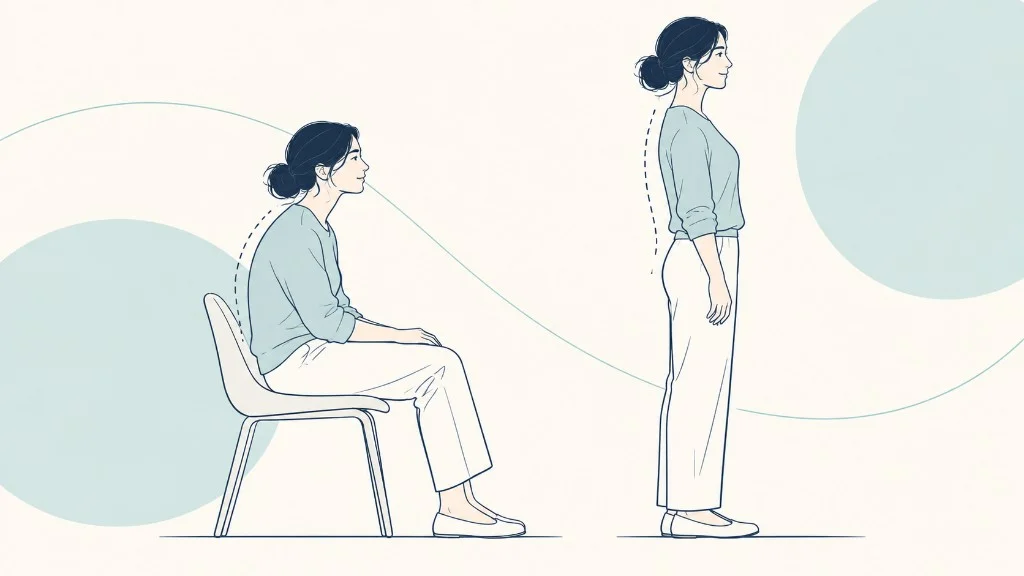
Posture is the claim that feels obvious because a camera can see it. A slump over a laptop is visible. The inside of a disc is not.
NIAMS says a desk job may play a role in back pain, especially if you have poor posture or sit all day in an uncomfortable chair. The word may is doing real work. The sentence is about pain and a job, not about a measured change in disc tissue, and it contains no percentage.
There is no posture percentage in the sources used here. None will be filled in to make the paragraph look finished.
The sentence to refuse is the one that ends posture advice with a promise about healing. Changing how you sit can change how a task feels that afternoon. A supported chair, a short walk, and a setup that does not make you crane forward are reasonable comfort experiments.
They do not rebuild a disc. This article will not say that a straighter posture heals one. You can prefer a chair and still have age-related degeneration on a scan.
You can also look “straight” in a photograph and have a painful day, because muscles, the hip, a nerve, and a long sit can all hurt. If a clinic explains your MRI from a posture score, ask what was measured in the people whose scans are being used as proof. Seeing a slump today is not that imaging review.
Position still matters as a clue, which is a smaller and better use. Pain that changes with standing or sitting can help a clinician think about muscles, the hip, and nerve patterns. That sorting is the subject of Lower Back Pain When Standing vs. Sitting.
A pattern is not a diagnosis. A diagnosis is not a picture of a disc caused by a chair from years ago. Keep the clue. Drop the origin story that the sources do not support.
Aging pictures are not a posture verdict
Brinjikji and colleagues reviewed spine imaging in people who did not have pain. Disc degeneration was present in about 37 percent of asymptomatic 20-year-olds and about 96 percent of asymptomatic 80-year-olds. The finding tracks age in people who were not chosen because their backs hurt.
A worn disc on a report is common. It is not a diary of someone’s chair, and it is not a confession that they lifted wrong.
Nothing in that review says posture caused those images. The gap between about 37 percent and about 96 percent follows age, in people without pain. If posture were the explanation those scans were built to test, posture would have had to be measured.
The review measured imaging features in asymptomatic groups. Using it as proof that posture wore the disc out borrows a picture and pastes on a cause.
The review does not say degeneration is always harmless. It says these changes are common without pain, so a picture alone cannot convict a habit or a disc. A finding matters clinically when its location fits the symptoms and the exam.
NIAMS notes a separate age pattern: back pain becomes more common with age, particularly after 45. More pain with age is not the same measurement as more degeneration on scans of people who are not in pain. You still cannot point at a slumped shoulder and call it the reason an 80-year-old’s disc looks different from a 20-year-old’s. NIAMS also says mechanical problems, inflammatory disease, and other conditions can overlap, and that sometimes no specific cause is identified.
What to do with the two claims in real life
Separate the health goal from the disc goal. If you and your clinician decide that a change in weight is worth pursuing, judge it by goals you can actually name: walking, sleep, other conditions you are already treating. Do not judge it by whether an MRI adjective disappears.
The meta-analysis never offered that endpoint. If pain eases while weight does not, that result is allowed. If weight changes and pain does not, that result is also allowed. It is not evidence that you failed a treatment the studies did not test.
Try the chair, the walking breaks, and a way of bending that does not light up leg symptoms. Keep what makes the day easier. Do not promote a provocative position into a theory that the discs are collapsing because you slouched. Nerve symptoms that build with walking and ease when you sit belong in a stenosis conversation, not in a posture grade.
Bring a short record if pain is sticking: what you were doing, whether pain stays in the back or travels, how far you walk before you need to sit, and what you have already tried, including any change in weight or workstation. The questions to prepare are one way to organize that record before a visit. They do not decide that you need an operation.
They do not score your posture. They do not turn an odds ratio into a candidacy rule.
A few symptoms should not wait on a posture plan or a weight plan. New trouble controlling bladder or bowel, numbness in the saddle area between the legs, or leg weakness that is worsening quickly needs urgent assessment. Severe back pain with fever is a different urgent problem. Those are not the ordinary ache the odds ratios describe.
Frequently asked questions
If I lose weight, will my low back pain go away?
The research does not say that. A meta-analysis found that obesity is associated with more low back pain in groups of people. That includes pain over the past year, seeking care, chronic pain, and new pain in studies that followed people over time. Association is not a test of a diet, and it does not name a number of pounds that repairs a disc. Judge a weight goal by the health targets you set with your clinician, and judge back pain by whether the pain and your walking actually change.
Is overweight linked with back pain, or only obesity?
In that same meta-analysis, overweight sat in between. The association was stronger for obesity than for the comparison group, and overweight was intermediate. This article quotes the obesity estimates because those are the pooled figures reported for the outcomes below. It does not invent a separate percentage for overweight. Intermediate means the pattern was graded, not that a few extra pounds are irrelevant or that they explain a scan. Your clinician can talk about your own weight without turning a pooled odds ratio into a personal forecast.
Can years of poor posture cause the discs to degenerate?
That has not been shown by the sources used here. A patient-education page says a desk job may play a role in back pain, especially with poor posture or a long day in an uncomfortable chair. May is not a degeneration study, and that page does not give a posture percentage. Disc degeneration on imaging is common with age in people who have no pain at all. A visible slump and a worn disc are different observations. Changing a chair can change how a workday feels. It is not evidence that the disc has been rebuilt.
My MRI says degenerative disc disease. Was that my sitting posture?
The MRI cannot answer that, and the imaging review used here did not measure posture. Disc degeneration was present in about 37 percent of people in their twenties who had no back pain, and in about 96 percent of people in their eighties who had no back pain. Those pictures track age. They were not sorted by who slumped at a desk. A report can be accurate and still not be the reason you hurt today. Ask whether the finding matches your symptoms and exam, not whether it matches a habit someone can see in a photograph.
Should I still work on my weight and how I sit?
Yes, if the goal is comfort and general health, and no, if the goal is a promise about a disc. A supported setup, walking breaks, and a way of lifting that does not provoke symptoms are reasonable experiments. Keep what makes the day easier. Weight can be part of a health plan your clinician supports, including load on other joints, without a bargain that the lumbar MRI will look younger. New trouble with bladder or bowel control, numbness in the groin or saddle area, or quickly worsening leg weakness needs urgent care, not a posture correction.
Key takeaways
- A meta-analysis of 33 studies found obesity associated with more low back pain, care-seeking, chronic pain, and new pain in cohort studies.
- Those results are group associations. They do not prove that losing a set amount of weight heals one person's disc.
- Overweight was intermediate between the comparison group and obesity. This article does not add an overweight percentage.
- Posture is not a proven cause of disc degeneration. Age-related scan changes are common in people without pain.
References
- Shiri R, Karppinen J, Leino-Arjas P, Solovieva S, Viikari-Juntura E. The association between obesity and low back pain: a meta-analysis. American Journal of Epidemiology. 2010;171(2):135-154. 2010.
- Brinjikji W, Luetmer PH, Comstock B, et al. Systematic literature review of imaging features of spinal degeneration in asymptomatic populations. American Journal of Neuroradiology. 2015;36(4):811-816. 2015.
- Back Pain. National Institute of Arthritis and Musculoskeletal and Skin Diseases (NIAMS), National Institutes of Health.
Prepare questions for your consultation
Organize your symptoms, imaging, and treatment history into clear questions for a spine specialist. The questionnaire does not decide candidacy.