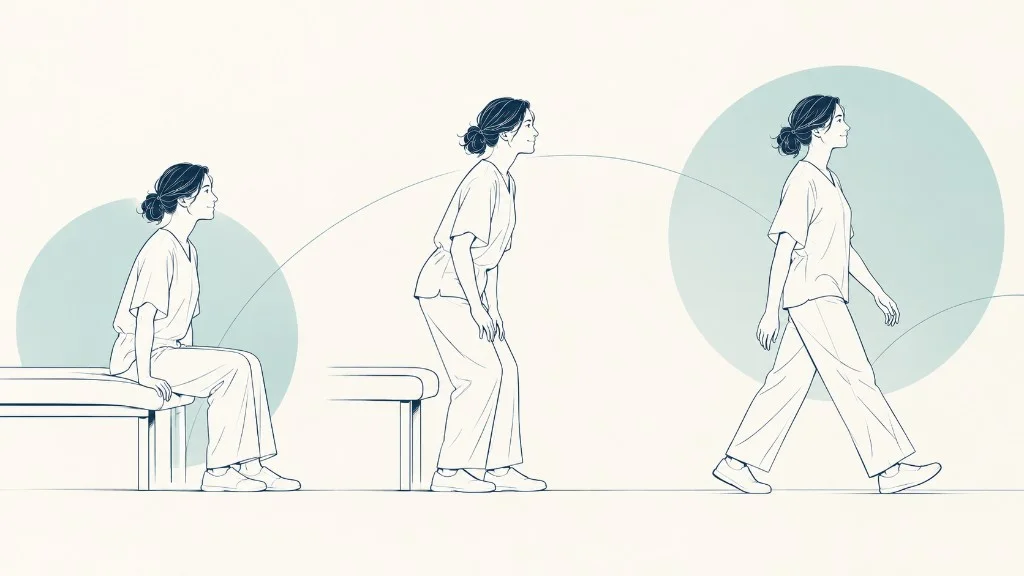
After a laminectomy, the first activity the American Academy of Orthopaedic Surgeons names is walking, encouraged as soon as possible. Most people also need some physical therapy, built for one person rather than copied from a general list. This article explains those statements and the academy’s broad lines about getting back to activity. It does not give you exercises to start.
Walking is the activity the academy names first
Decompression during a laminectomy removes bone, bone spurs, and ligaments that have been pressing on nerves. Once that is done, the academy’s recovery comments start with walking. “As soon as possible” is the phrase.
It is not a distance or a step count. Your team sets how far and how often for the first days.
Who goes home, and when, depends on health and on the procedure. Healthy people who have decompression alone may go home the same day or the next day. They may also return to normal activities after only a few weeks.
Both of those lines describe a relatively straightforward decompression in a healthy person. They are not a description of every laminectomy. If fusion was added, the stay is generally longer, which is covered below. If other medical problems need attention, the stay can change for that reason too.
Some people do not go straight home. The academy says older patients who need more care may go to a rehabilitation facility first. That is a plan for support with walking, self-care, and therapy under more supervision.
It is not a penalty for a slow first walk. If you live alone, or if stairs, bathing, or meals will be hard, say so before surgery. Discharge planning is easier when the team hears that early.
Walking is also the activity you can describe to a therapist later. Minutes that felt all right, legs that tightened, and a need to sit are useful notes. The operation was aimed at nerve pressure.
The walk is one way to see whether that symptom is easing. It is not a test you pass or fail on a fixed day.
While you are walking in the early period, one set of signs should interrupt the walk. Contact the team for wound redness, drainage, fever, new leg weakness, or new trouble with bowel or bladder control. Those are not the ordinary cost of a short walk.
They are reasons to call. The rest of the complication list, including problems that are uncommon and problems that are specific to the spine, belongs in a separate discussion. This page stays with activity.
What the therapy program is built to do
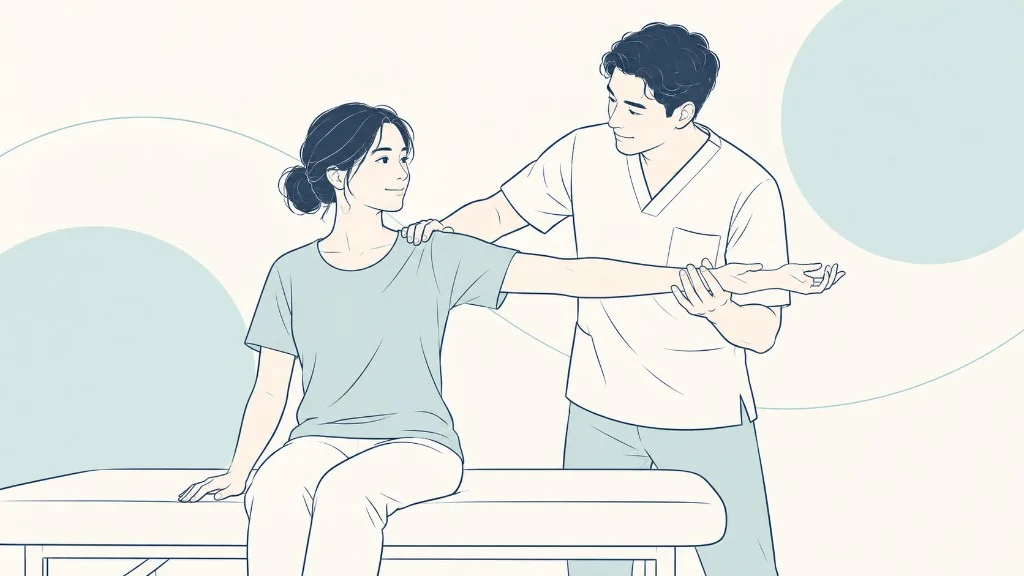
The academy says most people need some physical therapy after this operation. “Most” leaves room for a person whose team chooses a different path. It does not mean therapy is optional decoration, and it does not mean every clinic’s packet is the right packet.
The therapist builds an individual program. The pieces the academy names are strength, endurance, flexibility, and spinal stability, including the abdominal muscles.
Strength means the muscles can do a task more than once without giving out. Endurance means you can keep a walk or a daily activity going. Flexibility means you can move through the ranges the team allows, without forcing a motion they have limited.
Spinal stability, in this recovery setting, means the trunk muscles, including the abdominal muscles, can support the back during ordinary movement. That is training. It is not fusion, and it does not weld bone.
This page will not name the exercises. A move that helped someone else can be the wrong load for your incision, your levels, or a fusion if one was added. The team decides when therapy starts.
Starting earlier than they allow is not the individual program. If a start date was never set, ask for one.
Tell the therapist what the surgeon restricted. Tiredness after a session is not, by itself, a complication. New leg weakness, a sharp new pain down the leg, or a change in bladder or bowel control belongs in the call described above.
After surgery
What therapy is for, and what this page will not assign
The academy describes an individual program, and it does not publish an exercise list or a pound limit.
What the program works on
- Walking, encouraged as soon as possible.
- Strength and endurance for daily tasks.
- Flexibility within the limits you were given.
- Abdominal muscles as part of trunk support.
What stays with your team
- The day therapy is allowed to start.
- Which movements to avoid at first.
- Whether a brace is for comfort.
- Any lifting limit. None is stated here.
A program that fits another person's operation can be the wrong load for yours, especially if fusion was added.
A brace for comfort, and who sets pain medicine
A brace or corset may be given for comfort. The academy’s word is “may.” Some people wear one. Some never see one.
If you receive one, it is a support around the trunk for comfort, not a statement that the surgeon fused your spine, and not proof that the level is unstable. Ask when it should be on, when it can come off, and whether you wear it for walks. Buying a different brace because a neighbor used one is not part of the plan.
Comfort and stability are easy to tangle. Decompression makes room for nerves. It does not, by itself, stop motion between vertebrae.
A soft corset does not do that job either. If someone told you the level needed to be held still, that is a fusion conversation, or a conversation about how much bone was removed. It is not answered by tightening a brace another notch.
Pain medicine is also the team’s plan. The academy says a short course of opioid pain medicine, a few weeks, is typical after laminectomy. After fusion, the duration may be longer.
People who were already taking opioids may need them longer. Those sentences describe common practice. They do not tell you to start, stop, or add a medicine, including an anti-inflammatory pill.
Follow what you are given, and ask before you change it. This article will not give a lifting limit in pounds. The source does not give one.
Desk work and two lines about normal activities
The academy gives more than one general line about getting back to life, and they should stay side by side instead of being averaged into a single week.
Most people can return to a desk job within a few days to a few weeks. A desk job is not a construction job. Sitting, a commute, and the freedom to stand up all change whether “a few days” is realistic.
A person who must lift, drive for long stretches, or stand on a factory floor is not described by the desk sentence. Tell the team what the work actually is.
Healthy people who had decompression alone may return to normal activities after only a few weeks. Separately, the academy says people may return to normal activities after two to three months. Both sentences appear in its guidance.
This article will not pick a winner or split the difference and call the result your date. The few-weeks line is attached to healthy people and to decompression alone. The two-to-three-month line is the academy’s broader statement.
Age, other health problems, the number of levels, complications, and the surgeon’s protocol all change the timing. So does the kind of activity you mean by “normal.” A walk in the neighborhood, a shift at a desk, and a return to heavier exercise are three different bars.
| What the academy says | Who that line is about | What can move it |
|---|---|---|
| Home the same day or the next day | Healthy people who had decompression alone | Other illnesses, added procedures, and the need for more help at first |
| Normal activities after only a few weeks | The same healthier, decompression-alone group | Age, health, number of levels, complications, and the surgeon's protocol |
| Desk work in a few days to a few weeks | Most people, in the academy's general statement | The real demands of the job, including lifting, driving, and standing |
| Normal activities after two to three months | A broader general line, not a personal calendar | The same health and procedure factors, plus what "normal" means for you |
| Fusion adds two to three days in the hospital | People whose operation included fusion | A longer stay is not the whole fusion recovery. Bone healing takes longer than the extra hospital days |
Use those rows as questions, not as appointments. The week-by-week shape of recovery is the subject of Laminectomy Recovery Timeline Week by Week. Return to exercise and to work that is heavier than a desk is covered in Returning to Exercise and Work After a Laminectomy. This article does not rebuild those timelines.
When fusion was added to the operation
Fusion joins vertebrae so they can heal into one solid bone. The academy says fusion generally adds two to three days to the hospital stay. That is a difference in the early days, not a full account of fusion recovery.
The precautions come from the surgeon. This article will not turn into that guide. The longer path is outlined in Lumbar Spinal Fusion Recovery Timeline: What to Expect.
Two trials show why the operations should not share one therapy script. Försth and colleagues compared decompression plus fusion with decompression alone for lumbar stenosis, with and without degenerative spondylolisthesis, a slip related to worn joints and disc. At two years a disability score did not differ significantly.
Fusion meant a longer operation, more bleeding, and a higher cost. Ghogawala and colleagues studied a smaller group with grade I degenerative spondylolisthesis and stenosis. Fusion was linked with a larger gain on a physical-health score at two years, no significant difference on the disability score, reoperation that was less common over four years, and more blood loss plus a longer operation.
Those details are a warning about copying timelines. The trials were not studies of which exercises to do, and they do not supply a pound limit. They do show that “I had a laminectomy” is incomplete if fusion was added.
Tell the therapist which one you had. The few-weeks activity line is the academy’s line for healthy people after decompression alone. The extra hospital days are the fusion line. Your protocol is the one you follow.
What therapy is not asked to do
Therapy after laminectomy does not create the room the surgeon already made. If you are reading this before surgery, walks and exercises are not a substitute for deciding whether nerve pressure is the problem. If you are reading it afterward, therapy is how strength and stamina come back around a decompression that has already happened.
Therapy also does not decide whether the level is stable. Abdominal support can make daily movement feel steadier. That feeling is not fusion, and it is not proof the hardware is solid if hardware was used.
Imaging and the surgeon’s exam answer those questions. A therapist who is worried about new symptoms should send you back to the surgical team, not add a harder exercise to test the worry.
The result of the operation and the result of therapy are related and still different. The academy’s general statement is that laminectomy results, with or without fusion, are good to excellent in the majority of patients, with more improvement in leg pain than in back pain, and that most people can resume a normal lifestyle after recovery. “Majority” is not a percentage.
Leg pain and back pain are different results. Therapy can build the capacity to use a leg that hurts less. It cannot promise that back pain will vanish because the canal is wider. Judge walking, work, and comfort against the symptom you named before surgery.
If surgery is still ahead of you, and you want the recovery questions in writing before you decide, a set of questions to prepare can hold how far you walk now, what you have already tried, and what you would need therapy to restore. The questions do not decide that you need an operation. They do not set a therapy start date. They make it harder to leave the visit without knowing who will clear you to walk, who will build the program, and which of the academy’s general lines your surgeon thinks applies to you.
Frequently asked questions
Can I start exercises from a website the day I get home?
Not from this page, and not from a general list you found on your own. The academy says most people need some physical therapy, and that the therapist builds a program for that person. Therapy starts when the surgical team says it can start. An exercise copied from the internet is not that program. It skips the wound, the number of levels, and whether fusion was added. Use the walks the team has already encouraged, unless they have told you to wait. If a published move conflicts with your instructions, follow the instructions.
Does everyone leave the hospital with a brace?
No. The academy says a brace or corset may be given for comfort. Some people receive one and some do not. A brace for comfort is not fusion, and it is not proof that the level was unstable. If you are given one, ask when to wear it and when you can take it off. If you are not given one, that is also a plan. Do not buy a support on your own to fill a gap the team left open. Comfort is the reason the academy names. Stability is a different conversation.
What if I live alone and need more help at first?
The academy says older patients who need more care may go to a rehabilitation facility before they go home. That sentence is about support. People who are not older can also need help with meals, bathing, or a ride. Say so before the operation, while the discharge plan can still change. Home the same day or the next day describes healthy people after decompression alone. It is not a requirement you have missed if your health or your home is different. Ask who to call if walking at home feels unsafe.
Is therapy the same if fusion was added?
The goals can sound similar, and the operation is not. Fusion generally adds two to three days in the hospital, which is the academy's general line, not your discharge date. In two 2016 trials, adding fusion meant a longer operation and more bleeding or blood loss than decompression alone. Bone has to heal across the fused segments, which decompression alone does not ask it to do. The therapist still individualizes the work, and the surgeon still sets the precautions. Do not copy a decompression-only walking story onto a fusion, and do not treat this article as a fusion recovery guide.
When should I stop a walk or a therapy session and call?
Call the surgical team for wound redness, drainage, fever, new leg weakness, or new trouble with bowel or bladder control. Those signs are not ordinary effort, and they are not a reason to finish the session first. Soreness that fits what the team told you to expect can be reported at the next planned contact. This page cannot draw the line between expected surgical pain and a problem in your incision. The people who know your operation can.
Key takeaways
- Walking is encouraged as soon as possible. Most people need some physical therapy, built for strength, endurance, flexibility, and the abdominal muscles, and it starts when the team says so.
- A brace or corset may be given for comfort. It is not automatic, and it is not the same decision as fusion.
- Healthy people with decompression alone may go home the same day or the next day. Desk work is often a few days to a few weeks. The academy also gives two to three months as a general line for normal activities. Age, health, levels, complications, and the surgeon's protocol change all of those.
- Fusion generally adds two to three days in the hospital and is a larger operation. This page does not assign exercises or a weight limit in pounds.
References
- Lumbar Spinal Stenosis. OrthoInfo, American Academy of Orthopaedic Surgeons.
- Försth P, Ólafsson G, Carlsson T, et al. A Randomized, Controlled Trial of Fusion Surgery for Lumbar Spinal Stenosis. The New England Journal of Medicine. 2016;374(15):1413-1423. 2016.
- Ghogawala Z, Dziura J, Butler WE, et al. Laminectomy plus Fusion versus Laminectomy Alone for Lumbar Spondylolisthesis. The New England Journal of Medicine. 2016;374(15):1424-1434. 2016.
Prepare questions for your consultation
Organize your symptoms, imaging, and treatment history into clear questions for a spine specialist. The questionnaire does not decide candidacy.